
Space tech, telecom to push digital services to remote areas: Vaishnaw
Space and telecom are "organically connected" sectors, especially with regard to managing spectrum, he observed
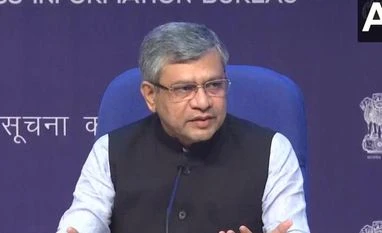 "Space tech, telecom to push digital services to remote areas: Vaishnaw")
WebinarsNew
Deep DiveNew
Explore Business Standard
Space and telecom are "organically connected" sectors, especially with regard to managing spectrum, he observed
The combination of space technology and telecom will propel the reach of digital services to remote areas and lead to inclusive development, Minister for Communications and IT Ashwini Vaishnaw said on Monday, underlining the government's commitment to reforms in the sector.
The Minister exhorted the captains of the industry to study global best practices in areas such as spectrum management and come up with suggestions that would contribute towards the formulation of an enabling policy, as well as benchmarks that India can adopt.
Space and telecom are "organically connected" sectors, especially with regard to managing spectrum, he observed.
Noting that the Indian Railways is also a big consumer of space technologies in areas such as planning, efficient movement of trains, crisis management, and communications services at places where fibre and telecom towers are not available, Vaishnaw urged industry to do detailed study with the Railway officials and the Space Department and offer suggestions on applications that can be adopted to make Railways more efficient.
The combined might of space technologies and telecom would also contribute in a "big way" towards inclusive development, the Minister said speaking at an event to mark the launch of the Indian Space Association.
"It is very obvious that space and telecom combined can help us reach areas which are conventionally not reachable... like forested areas, the tribal areas which are in very remote places... in North Eastern parts of our country, the Himalayan sections, the desert areas... Many of these sections where conventional methods could not take digital services, I hope with space technologies we will be able to reach those areas," he said.
Terming space and telecom as organically connected sectors, especially when it comes to managing spectrum, the Minister said that the subject is a complex one and asked the industry leaders to study global best practices on the subject and come up with benchmarks that India can adopt.
"We are an open-minded government. We want to reform this sector and provide level-playing-field to everybody. We want that there should be healthy competition in this sector. So please come up with recommendations which will help us formulate policy in that direction," Vaishnaw added.
The launch of Indian Space Association, will open up new opportunities for industry, research organisations, academia, startups, manufacturers, service organisations like Railways and others.
"So many things are changing, so many technologies are coming up. This is a time when we need a body which can really think through, sit together, deliberate and come up with policy recommendations, which can help in the long-term development of the sector" he said.
The just-launched Indian Space Association (ISpA) is positioning itself as an industry body of space and satellite companies.
ISpA is represented by leading homegrown and global corporations with advanced capabilities in space and satellite technologies. Its founding members include Bharti Airtel, Larsen and Toubro, Nelco (Tata Group), OneWeb, Mapmyindia, Walchandnagar Industries and Ananth Technology Limited.
Other core members include Godrej, Hughes India, Azista-BST Aerospace Private Limited, BEL, Centum Electronics, Maxar India.
Jayant Patil, Senior Executive Vice President - Defence, L&T-NxT is the first Chairman of ISpA and Rahul Vatts, Chief Regulatory Officer, Bharti Airtel has been appointed as Vice Chairman. AK Bhatt has been named the Director General of the new association.
Satellite communication is playing a key role in global connectivity, linking remote and far-flung sites, enabling backhaul connectivity to mobile infrastructure, and establishing critical communication in emergency situations.
The growing constellation of Low Earth Orbit (LEO) satellites, planned and being deployed by SpaceX, Bharti-backed OneWeb, those by Telesat and others have sparked renewed interest in this space.
LEO satellites are expected to fuel availability of high-speed broadband access, at potentially reduced costs compared to conventional geostationary satellite systems, according to experts.
(Only the headline and picture of this report may have been reworked by the Business Standard staff; the rest of the content is auto-generated from a syndicated feed.)
First Published: Oct 11 2021 | 2:39 PM IST


 Connect with us on WhatsApp