Statsguru: New indirect tax regime

The rates have allayed fears that the GST would be inflationary in the short term
(Click on picture for details)
Ishan Bakshi
Last Updated : May 28 2017 | 11:34 PM IST
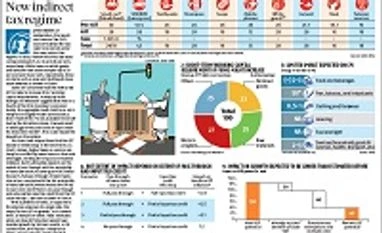
After months of deliberation, the Goods and Services Tax (GST) Council finalised the tax rates to be levied under the new indirect tax regime. As such, there will be four tax slabs corresponding to 5, 12, 18 and 28 per cent, respectively. While taxes on white goods and telecom have been bumped up to 28 per cent and 18 per cent, respectively, those on items such as soap and toothpaste have been lowered as shown in Chart 1. 

Some are concerned that the shift to the GST is likely to increase firms’ working capital requirements. A study by India Ratings and Research suggests that even if a fourth of the firm inventory is procured locally, the aggregate input credit lock-up is likely to be roughly Rs 1 lakh crore (Chart 2). Even if half of this “is not available for set off during the transition phase, it would result in blockage of Rs 50,000 crore of input credit for about two month”. This could impact the liquidity in the system. 

The rates have allayed fears that the GST would be inflationary in the short term. As Chart 3 shows, higher taxes on services are likely to be offset by lower taxes on food and beverages, limiting the impact on headline inflation. But it ultimately depends on the extent of pass through and the availability of input tax credit. According to HSBC Global Research, full pass through of lower taxes into prices, coupled with the full availability of input tax credit, would reduce the CPI by 0.8 per cent. But if there is no pass through and only partial input tax credit then the CPI could rise by 1.2 per cent as seen in Chart 4. 

With a plethora of rates, as opposed to the original proposal of a single rate, the impact of the GST on growth, in its current form, is likely to be lower. HSBC estimates while an ideal GST structure would have boosted growth by 130 basis points, in its current form, the impact is likely to be lower, around 40 basis points (Chart 5).

(Click on picture for details)


One subscription. Two world-class reads.

Already subscribed? Log in

Subscribe to read the full story →
*Subscribe to Business Standard digital and get complimentary access to The New York Times

Smart Quarterly

₹900

3 Months

₹300/Month

SAVE 25%

Smart Essential

₹2,700

1 Year

₹225/Month

SAVE 46%
*Complimentary New York Times access for the 2nd year will be given after 12 months

Super Saver

₹3,900

2 Years

₹162/Month

Subscribe

Renews automatically, cancel anytime

Here’s what’s included in our digital subscription plans

Exclusive premium stories online

  • Over 30 premium stories daily, handpicked by our editors

Complimentary Access to The New York Times

  • News, Games, Cooking, Audio, Wirecutter & The Athletic

Business Standard Epaper

  • Digital replica of our daily newspaper — with options to read, save, and share

Curated Newsletters

  • Insights on markets, finance, politics, tech, and more delivered to your inbox

Market Analysis & Investment Insights

  • In-depth market analysis & insights with access to The Smart Investor

Archives

  • Repository of articles and publications dating back to 1997

Ad-free Reading

  • Uninterrupted reading experience with no advertisements

Seamless Access Across All Devices

  • Access Business Standard across devices — mobile, tablet, or PC, via web or app

Next Story



