In a way, 2005 was the year of memoranda of understanding for steel. Mega greenfield projects were set to add more than 100 million tonnes of capacity. So, when the government came out with the National Steel Policy the same year that set a goal of 100 million tonnes in production by 2019-20, it was seen as an easy target.
The installed capacity in India today, the third largest steel producer globally, is 122 million tonnes. However, even though India has surpassed its target capacity, the utilisation in the sector is 75-80 per cent. In that backdrop, how realistic is the target of a 300 million tonne capacity by 2030, as set by the National Steel Policy 2017?
The real challenge is consumption, says Steel Authority of India Chairman P K Singh. “The government intends to take capacity to 300 million tonnes by 2030 and we require a good policy for that. We will not achieve that kind of capacity unless we have strong foundations for it. Today, production is around 90 million tonnes; for three times that production, we need sound policies,” Singh says.
The policy strikes the right chord by highlighting the potential that India offers in terms of growth in per capita consumption of steel, which at 61 kg is way below the world average of 208 kg.
Rajiv Kumar, vice-president of Tata Steel’s Kalinganagar plant, points out that in Tier II cities, the per capita consumption is 160-170 kg, but in the villages, it’s around 30 kg.
The government is doing its bit to boost consumption by coming out with a policy to provide preference to domestically manufactured iron and steel in government procurement. The policy is applicable on all government tenders where the price bid is yet to be opened.
Also, with the Real Estate Regulation Act coming into effect from May 1, 2017, the demand for steel is likely to increase. According to CARE Ratings, most of the demand, however, will come from the government spending on infrastructure, railways and roads.
“Currently around 40 per cent of the steel consumption is from the construction and infrastructure sectors, which is expected to increase to around 60 per cent by 2030-31,” CARE Ratings said in a report.
Infrastructure spending would have a two-fold impact on the industry, points out JSW Director (commerce & marketing) Jayant Acharya. “On the one hand, it would boost steel consumption; on the other, it would create the entire ecosystem required for the enhanced capacity.”
Each tonne of steel requires three tonnes of raw material, 300 million tonnes of steel would mean 900 million tonnes of raw material. Railways, ports, the infrastructure would have to have that kind of handling capacity. The policy envisages an additional employment of 1.1 million, depending on the degree of employment.
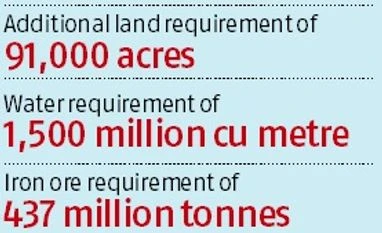
Despite low consumption and land acquisition hurdles, steelmakers though will continue to add new capacity. There is the added concern that the 300 million tonne capacity takes into account Greenfield projects where land could be a major a hurdle. According to the National Steel Policy, the land requirement is estimated to be 91,000 acres, factoring in greenfield expansion.
“I don’t know whether there will be a positive land acquisition policy, going forward. The steel industry requires a lot of land,” says Kumar.
But even if greenfield projects hit the land hurdle, there is no doubt that primary producers are likely to go ahead with brownfield expansion, to keep their market share intact.
India’s top steelmakers, SAIL, JSW Steel and Tata Steel have added capacities totalling 16.7 million tonnes in the last decade, that’s 21 per cent of the country’s capacity addition during the period, by sweating existing land assets.
But there are other ifs and buts. To achieve a capacity of 300 million tonnes would mean an additional investment of Rs10 lakh crore. Though brownfield expansion would require less investment than greenfield, it would still be significant.
According to the RBI’s Financial Stability Report, the stressed advanced ratio was the highest for basic metals and their products at 42.9 per cent as of September 2016. “Therefore, the banking system hasn’t been lending much to the industry which has to depend progressively on the bond market,” the report said.
But with improved cash-flows on the back of the various government measures and a global demand recovery, the industry appears to be getting back on its feet.




