Stubble burning: This formula could have saved Delhi its smog menace

CII, NITI Aayog said farmers need to be aided financially to shift to an alternative method of dealing with agriculture waste
BS Web Team New Delhi
Last Updated : Nov 13 2017 | 1:32 PM IST
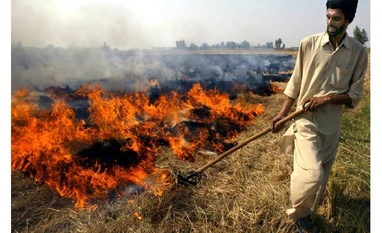
Stubble burning in North and North-west India has been cited as a major reason for dense smog and heavy air pollution in Delhi. A report in The Indian Express says that the burning of crop residue by farmers could have been averted if the Centre and states concerned had reached an agreement to share a proposed financial incentive package for farmers.

The unabated stubble burning, especially in Punjab and Haryana, estimated to be around 35 million tonnes, was banned by the National Green Tribunal in November 2015. 

Cleaner Air initiative, formed under the Confederation of Indian Industry (CII) and NITI Aayog (National Institution for Transforming India), had said farmers needed to be aided financially to stop the burning and shift to an alternative method of dealing with agriculture waste.

One such idea proposed was burning waste without the presence of oxygen in a brick-and-clay dome-like structure that would produce biochar, a carbon-rich residue containing high soil nutrients.

However, the initiative also noted that farmers must also be provided monetary aid to hire the labours required for the method. CII-NITI Aayog task force calculated this amount to be around Rs 1,500 cr in Punjab and other states concerned such as Rajasthan, Haryana and Uttar Pradesh.

Last week, the Delhi High Court had said stubble burning was the "visible villain" behind severe air pollution, coupled with other contributory factors to the "grave" environmental situation in the national capital. Thick smog, mainly caused by stubble burning continued to envelop many parts of Punjab and neighbouring Haryana, which also changed school timings to 9 am to 3.30 pm till November 30.


As it could not be decided as to who would finance the aid for farmers, the package could not be rolled out. Besides, the absence of a market for biochar would most likely discourage farmers from adopting the technique, if rolled out next year.

Punjab Chief Minister Amarinder Singh had recently written to Prime Minister Narendra Modi seeking compensation for farmers for crop residue management to check the dangerous trend of stubble burning.

Singh also requested the prime minister to convene a meeting on the issue among chief ministers of the affected states, along with the Union ministers for agriculture, food and environment.

The Union agriculture ministry last week said it had issued an advisory to state governments to check stubble burning that caused severe pollution in the National Capital Region in the past few days. The advisory came in the wake of the National Green Tribunal's (NGT's) strict warning to states for measures to stop stubble burning.

"It has been brought to our notice that huge crop residue burning is going on in Karnal, Haryana... We direct all the pollution control boards and departments concerned of Haryana, Punjab, Uttar Pradesh and Rajasthan to ensure that there is no stubble burning anymore," NGT chairperson Justice Swatanter Kumar said.

The ministry has asked the states of Punjab, Haryana, Uttar Pradesh and Rajasthan to create awareness among the farmers about the harmful effects of straw burning and provide the necessary means to them for effective disposal of the stubble.

It has also directed the states to use the funds of Rs 4,000 per hectare available under the Sub-Mission on Agricultural Mechanisation to provide straw management machinery and equipment to farmers, as per the release.

These include zero till seed drill, happy seeder, straw baler, rotavator, paddy straw chopper or mulcher, gyro rake, straw reaper and shredder.

The ministry has also asked the states to make available the machinery and equipment through custom hiring centres or village level farm machinery banks.

One subscription. Two world-class reads.

Already subscribed? Log in

Subscribe to read the full story →
*Subscribe to Business Standard digital and get complimentary access to The New York Times

Smart Quarterly

₹900

3 Months

₹300/Month

SAVE 25%

Smart Essential

₹2,700

1 Year

₹225/Month

SAVE 46%
*Complimentary New York Times access for the 2nd year will be given after 12 months

Super Saver

₹3,900

2 Years

₹162/Month

Subscribe

Renews automatically, cancel anytime

Here’s what’s included in our digital subscription plans

Exclusive premium stories online

  • Over 30 premium stories daily, handpicked by our editors

Complimentary Access to The New York Times

  • News, Games, Cooking, Audio, Wirecutter & The Athletic

Business Standard Epaper

  • Digital replica of our daily newspaper — with options to read, save, and share

Curated Newsletters

  • Insights on markets, finance, politics, tech, and more delivered to your inbox

Market Analysis & Investment Insights

  • In-depth market analysis & insights with access to The Smart Investor

Archives

  • Repository of articles and publications dating back to 1997

Ad-free Reading

  • Uninterrupted reading experience with no advertisements

Seamless Access Across All Devices

  • Access Business Standard across devices — mobile, tablet, or PC, via web or app

Next Story



