Tale of two cities: On urban connectivity, Delhi races ahead of Mumbai

The capital has an edge over Mumbai with its new expressways; Mumbai's shape doesn't lend itself to inter-city expressways
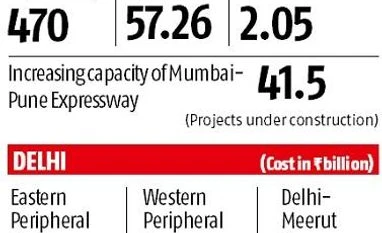
Chart
.
Megha ManchandaAmritha Pillay New Delhi/Mumbai
Last Updated : Dec 14 2018 | 2:00 AM IST
On urban mobility, Delhi and Mumbai have turned out to be very different. While Delhi has nearly half a dozen expressways to transport people living in the National Capital Region (NCR), Mumbai lags behind in connectivity, despite a higher population.

In the last one year, several expressways have come up in the NCR — the Eastern Peripheral Expressway (Kundli-Ghaziabad-Palwal), the Delhi-Meerut Expressway and the Western Peripheral Expressway (Kundli-Manesar-Palwal) — to improve the traffic flow and reduce commuting time, especially for those who travel from neighbouring cities to go and work in Delhi and the adjoining regions of NOIDA and Gurugram.

Mumbai has been unable to make much headway with similar projects. The list of reasons holding back projects aimed at connecting different parts of the city is long. “In a city like Mumbai, there are various reasons including delays in the formation of a master plan. By the time, a master plan is in place, the said road has been encroached,” said a senior official from the Mumbai Metropolitan Region Development Authority. 


Other reasons for delays range from difficulties in land acquisition and inadequate funds to rehabilitation issues, insufficient expertise in the agency involved, and a multiplicity of agencies involved with urban infrastructure. 

“The city’s infrastructure projects are being developed from a crisis management point of view. They should have been developed earlier from a future planning perspective. However, with the proposed metro line which will have the potential to carry eight million passengers daily, the situation is bound to improve,” said the official. 

Vinayak Chatterjee, chairman, Feedback Infra Group said that Mumbai did score higher in one respect. “Delhi has a fair share of expressways in and around it whereas Mumbai has a robust suburban network, which the national capital does not have.”


In fact, Mumbai used to be far ahead of Delhi in terms of public transport systems because of the suburban train network which is one of the largest and cheapest in the world. Delhi also has Diesel Mobile Units and Electric Mobile Units for neighbouring cities, but these could never match up to Mumbai locals.
Mumbai’s suburban rail system connects the city to its suburbs in the north through three different rail routes, namely the western, central, and harbour lines. According to the Mumbai Rail Vikas Corporation, eight million passengers travel on this rail system every day.  

According to the latest census data of 2011, larger urban Mumbai has a population of 18.4 million, while 12.4 million people reside in its municipal area. For Delhi, the population is 33 per cent lower at 16.3 million in the urban agglomeration and 11 million in the municipal area.


The capital began to gain an advantage over Mumbai with its 317-km long Delhi Metro network which has gradually spread across Delhi, Gurugram, Faridabad, Ballabhgarh, NOIDA, and Ghaziabad over the last 16 years. 

 
Part of the reason for bad road connectivity in Mumbai is its geography. It is a linear city, unlike Delhi which has multiple entry points. Mumbai’s road network mainly consists of two express highways – the eastern express highway and the western express highway.  “Being a linear city, traffic in the city moves one way. Even the National Highway-8 touches Mumbai from outside and then goes to another place,” said Vishwas Udgirkar, partner, Deloitte India. Currently, there are infrastructure projects worth about Rs1.6 trillion either starting from Mumbai or from in and around the city. Of these, Mumbai’s Rs826 billion metro system project which is currently under construction will be commissioned in phases, with the first phase to start in 2019. The Rs 470 billion Mumbai- Nagpur expressway will also be commissioned next year.  

According to Udgirkar, Mumbai is a perfect candidate for developing coastal roads and sea links for which more innovative transport planning is needed. As it turns out, the Maharashtra State Road Development Corporation has awarded tenders to build the Mumbai Coastal Road which will run along the city’s coastline, connecting the southern part of the city to its western suburbs. 

One subscription. Two world-class reads.

Already subscribed? Log in

Subscribe to read the full story →
*Subscribe to Business Standard digital and get complimentary access to The New York Times

Smart Quarterly

₹900

3 Months

₹300/Month

SAVE 25%

Smart Essential

₹2,700

1 Year

₹225/Month

SAVE 46%
*Complimentary New York Times access for the 2nd year will be given after 12 months

Super Saver

₹3,900

2 Years

₹162/Month

Subscribe

Renews automatically, cancel anytime

Here’s what’s included in our digital subscription plans

Exclusive premium stories online

  • Over 30 premium stories daily, handpicked by our editors

Complimentary Access to The New York Times

  • News, Games, Cooking, Audio, Wirecutter & The Athletic

Business Standard Epaper

  • Digital replica of our daily newspaper — with options to read, save, and share

Curated Newsletters

  • Insights on markets, finance, politics, tech, and more delivered to your inbox

Market Analysis & Investment Insights

  • In-depth market analysis & insights with access to The Smart Investor

Archives

  • Repository of articles and publications dating back to 1997

Ad-free Reading

  • Uninterrupted reading experience with no advertisements

Seamless Access Across All Devices

  • Access Business Standard across devices — mobile, tablet, or PC, via web or app

Next Story



