Tamil Nadu CM asks PM to continue with current OBC reservation policy

The government had reserved 27 per cent of the vacancies in civilian posts and services falling under its purview for the OBCs to be filled through direct recruitment
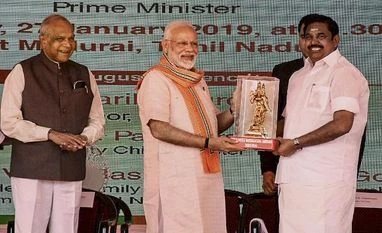
Prime Minister Narendra Modi being felicitated by Tamil Nadu Chief Minister K Palaniswami at the foundation stone laying ceremony of All India Institute of Medical Sciences (AIIMS) in Madurai
Prime Minister Narendra Modi being felicitated by Tamil Nadu Chief Minister K Palaniswami . File Photo
T E Narasimhan Chennai
2 min read Last Updated : Jul 08 2020 | 9:07 PM IST
Tamil Nadu on Wednesday asked th Centre to continue with the existing policy of determining the creamy layer by excluding agricultural and salary income. The state also suggested that the government consider providing OBC reservations by following the Tamil Nadu model, which would benefit the backward classes across the country equitably and render complete social justice.
Tamil Nadu Chief Minister K Palaniswami quoted media reports stating that the government was contemplating the revision of the criteria for creamy layer among OBCs by including salary and agricultural income.  These are currently excluded from the calculation of income for the purpose of determining the creamy layer for OBCs.
 
The government had reserved 27 per cent of the vacancies in civilian posts and services falling under its purview for the Other Backward Classes (OBCs) to be filled through direct recruitment, subject to the condition that the aforesaid reservation shall not be applied to persons/sections specified as creamy layer from amongst OBCs.
 
There are six criteria for assessing the persons to be excluded as creamy layer within OBCs. One of the criteria specifies income limit for exclusion from the OBC category. The income limit of the parents for the wards to whom OBC status can be claimed, was fixed at Rs 1 lakh per annum initially in the year 1993. Subsequently, the income limit was revised Rs 8 lakh with effect from September 1, 2017.
 
If salary and agricultural income of the parents are considered to be a part of the overall income of the parents, this would disallow OBC status to several deserving OBC candidates from availing reservation in jobs, as well as welfare schemes under the Central government.

One subscription. Two world-class reads.

Already subscribed? Log in

Subscribe to read the full story →
*Subscribe to Business Standard digital and get complimentary access to The New York Times

Smart Quarterly

₹900

3 Months

₹300/Month

SAVE 25%

Smart Essential

₹2,700

1 Year

₹225/Month

SAVE 46%
*Complimentary New York Times access for the 2nd year will be given after 12 months

Super Saver

₹3,900

2 Years

₹162/Month

Subscribe

Renews automatically, cancel anytime

Here’s what’s included in our digital subscription plans

Exclusive premium stories online

  • Over 30 premium stories daily, handpicked by our editors

Complimentary Access to The New York Times

  • News, Games, Cooking, Audio, Wirecutter & The Athletic

Business Standard Epaper

  • Digital replica of our daily newspaper — with options to read, save, and share

Curated Newsletters

  • Insights on markets, finance, politics, tech, and more delivered to your inbox

Market Analysis & Investment Insights

  • In-depth market analysis & insights with access to The Smart Investor

Archives

  • Repository of articles and publications dating back to 1997

Ad-free Reading

  • Uninterrupted reading experience with no advertisements

Seamless Access Across All Devices

  • Access Business Standard across devices — mobile, tablet, or PC, via web or app

Topics :OBC reservationReservationsTamil NaduNarendra Modi

Next Story



