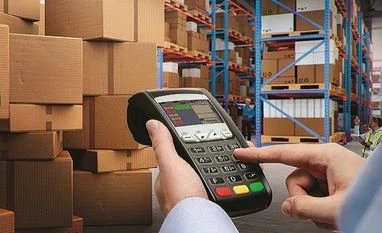
The Reserve Bank of India’s data does not reflect a deployed base of six million units ever (it may have taken into account only “active” units). Says Deepak Chandnani, managing director for Worldline South Asia and Middle East operations: “There was a clean-up in the reported numbers, and it now more accurately reflects terminals deployed in the field.”
All this, even as a whole swathe of businesses saw their fortunes plummet. “Salons, spas and sport goods outlets saw little business during the pandemic. Nearly 40 per cent of them may not even come back to life,” says Ketan Patel, chief executive officer of Mswipe Technologies.
The big bet is on the $700-billion local retail sector — 90 per cent of which is made up of neighbourhood kirana stores. On-boarding them digitally is now easier, given the surge in smartphone adoption, and existing low-cost data plans. This has given a fillip to new-age PoS machines, which operate on Android and offer affordable all-in-one solutions to merchants.
What must also be noted is that there are far more places to spend compared to the pieces of plastic to swipe with — 898.20 million debit cards and 62.05 million credit cards. At Palladium in Mumbai or DLF Emporio in New Delhi, the number of PoS units, the swipes on them, the kinds of cards used, the volumes and value of transactions will far outstrip the thousands at other smaller avenues on the same payment network.
Even before the pandemic, PoS deployers had been hit hard owing to the move to do away with the merchant discount rate (MDR) levied on merchant outlets every time someone transacts. The MDR is shared by the participants who run the business — issuers, acquirers, the networks (Visa, Mastercard and RuPay), and non-bank deployers.
On a debit card transaction of over Rs 2,000, the MDR is 0.90 basis points (bps), of which 0.60 bps goes to issuers, with 0.10 bps to the acquirer; others who make up the loop get to keep what’s left. This is only illustrative; it can vary hugely, depending on how these arrangements have been crafted.
It created distress. Business outlets with an annual turnover of more than Rs 50 crore were to offer low-cost digital modes of payment to their customers and no MDR was to be imposed on both customers and merchants. The technical issue here was that there is no MDR up to Rs 2,000, which is on ticket size. The Rs 50 crore was related to turnover. The point was, what would happen to everything that falls in between?
Again, why should there be no MDR on outlets with a turnover of more than Rs 50 crore? If anything, they should have a higher capacity to absorb the MDR. It’s now history, but it singed the business. So, what has changed?
Take Mswipe, a large part of whose revenue is based on the platform-usage fee, not the MDR. It’s like Netflix’s strategy — pay a flat monthly subscription and use whatever you want and however much you want. Merchants get transaction processing, checkout finance, equated monthly instalments and a plethora of applications that helps in making business better, as well as access to loans and a lending platform.
“We are not a company that makes money out of MDR. For a tech-first merchant commerce platform company like ours, we have built a robust tech-stack,” points out Mehra. Pine Labs also helps merchants accept multiple modes of digital payments, offer pay-later options to customers, enable contactless payment modes like digital QR and do a lot more using just a single PoS interface.
Its Plutus Smart PoS device comes with an integrated app ecosystem that helps small retailers manage their business better. Small retailers operating grocery, mobile stores, and small pharmacies no longer need to deploy several different kinds of software and devices to meet their business needs.
A largely MDR-driven business is now more an inventory management system and bookkeeping platform on Linux and Android-PoS. “There has been integration between PoS terminals and the back-end of large retail stores. Smart terminals now have screens and the ability to download certain apps, including inventory management ones, besides taking care of their digital payments needs,” says Chandnani.
Adds Patel, “Firms like ours will move from just being deployers to offering payment solutions, bookkeeping and value-added services. We have a finance arm as well, and a small finance bank licence is also on the cards.”
Clearly, there is a world beyond the swipe.
One subscription. Two world-class reads.
Already subscribed? Log in
Subscribe to read the full story →
Smart Quarterly
₹900
3 Months
₹300/Month
Smart Essential
₹2,700
1 Year
₹225/Month
Super Saver
₹3,900
2 Years
₹162/Month
Renews automatically, cancel anytime
Here’s what’s included in our digital subscription plans
Exclusive premium stories online
Over 30 premium stories daily, handpicked by our editors


Complimentary Access to The New York Times
News, Games, Cooking, Audio, Wirecutter & The Athletic
Business Standard Epaper
Digital replica of our daily newspaper — with options to read, save, and share


Curated Newsletters
Insights on markets, finance, politics, tech, and more delivered to your inbox
Market Analysis & Investment Insights
In-depth market analysis & insights with access to The Smart Investor


Archives
Repository of articles and publications dating back to 1997
Ad-free Reading
Uninterrupted reading experience with no advertisements


Seamless Access Across All Devices
Access Business Standard across devices — mobile, tablet, or PC, via web or app
)