The dingy office in Abdul Qadeer’s truck building workshop on the Delhi-Uttar Pradesh border has an old, shabby desk and a Koryo television set that costs Rs 10,000. Though his preferred brand is Samsung, Qadeer went for the cheaper brand of television because the slump in his business is forcing him to cut costs wherever he can.
A truck cabin maker named Ravi, one of his service providers, comes in to check if there is any new work order. Until last year, Ravi, who charges Rs 4,500 per cabin assembly, used to turn out five cabins a month. These days he works on a single cabin for a month and clubs it with some daily wage work, as and when he gets it.
“In my 25 years in this business, I have never seen such a drop in demand. Last summer, the entire yard was filled with new commercial vehicles (CVs), and now we just have one truck,” exclaims 39-year-old Qadeer, who joined his father’s business when he was barely out of school.
The slump that Qadeer is facing is a direct fallout of the decline in the sales of commercial vehicles, especially medium and heavy CVs (M&HCVs), which generally do not come as fully built trucks for retail buyers, and hence require external body building. M&HCV sales dropped more than 50 per cent in September and October this year, while their vehicle registrations declined by nearly 20 per cent.
If we look at macro indicators, the index of industrial production of automobiles contracted by 25 per cent in September, while that of capital goods, including CVs, declined by 20 per cent. All the forward linkages of CVs are thus under severe economic stress, including thousands of informal workers who work at these units.
Tata Motors, India’s largest manufacturer of M&HCVs, says that fully-built vehicles account for more than 90 per cent of their rollout. “However, in the multi-axle rigid trucks, many customers still buy cowl chassis and build bodies through local body builders,” says Girish Wagh, president at the commercial vehicles business unit at Tata Motors.
Hit hard by the downturn, transport companies are also cutting costs. “Our trips are not recovering even the operating costs. We have had to do layoffs. Forget fleet addition, it is now difficult to pay the interest on loans for recently bought trucks,” says H P Singh, vice president, north India, at Agarwal Packers and Movers.
Says Qadeer, “Truck owners used to line up at our yard. Up until 2018, they would urge us to give them preferential treatment. But now they are holding back their orders, leaving chassis unbuilt till their transport orders grow.”
The pain gets amplified when it comes to the workers. Even last year, Qadeer employed more than 30 skilled workers in his yard. Today, he has only four workers and even they don’t have much to do. One worker has returned to his hometown in Bihar to save on food and rent. Qadeer has lent him Rs 5,000, which will be deducted from any future payout.
However, Ravi is staying on. “Welding painting wale mil jaate hain, cabin ka specialist hota hai (Welders and painters are available in plenty, cabin making is a special skill),” he says
The Goods and Services Tax (GST), implemented in 2017, is also giving a hard time to people like Qadeer. In the pre-GST regime, the excise duty on the CV chassis was paid by the CV maker. The body builder would charge a flat rate according to the size of the chassis and levy service tax at 12 per cent, which later rose to 15 per cent.
Now, GST at the rate of 18 per cent needs to be recovered from the trucker. “This shows up on the bill as a higher tax burden than before,” says Qadeer.
The chassis of a typical trailer/container truck costs around Rs 20 lakh for a new model. The cost of body building is about Rs 3 lakh, or nearly 10-15 per cent of the price of the truck. “We end up paying Rs 54,000 as GST for a work order of Rs 300,000. We lose the input-tax credit in many cases where buyers are non-compliant,” says another CV body building player.
Other truck builders in the area, who did not wish to be identified, reveal that illegal practices are flourishing once again. For example, agents are getting a body-built CV registered at the regional transport office without the mandatory invoice from the builder.
Also, while input costs to run a transport business have risen, there is a tendency to short-change the transport bills due to weak demand.
The high cost of diesel is also a factor. “Diesel is costlier now, after deregulation and the hike in excise duty. Tel ke daam gire hain lekin diesel pehle se mehenga padta hai,”
Around 20 miles away, at the Delhi-Haryana border, is the Sanjay Gandhi Transport Nagar, which houses many wooden truck body builders. Ram Narayan, who supplies the raw material for a truck cabin, laments that only 10 vehicles are being readied and rolled out of the hub per month. “At most 2-3 trucks are being done per week now, where there used to be 4-5 trucks done per day,” he tells Business Standard.
Qadeer does not know when the slowdown will end. “Only if people demand more clothes, more two wheelers, more refrigerators, will the transporters get orders. It is only then that they will buy new container trucks, and I will get an opportunity to build a few of them,” he says.
Ravi, on the other hand, is worried about making ends meet for his family. He is borrowing money to meet some of his expenses.
“If the slowdowndoes not end soon, I will start selling socks at Dilshad Garden metro station,” he says with hopelessness.

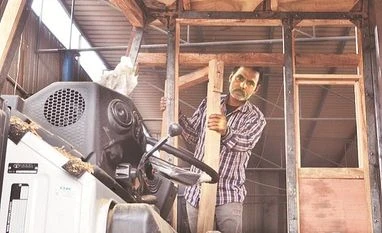 "Truck body builders struggle to wade through ongoing economic slowdown")











