Former NITI Aayog vice-chairman Arvind Panagariya believes the Congress’ promise of NYAY will seriously damage fiscal consolidation, and large subsidies will have to be cut. However, he tells Indivjal Dhasmana in an interview that he is glad both sides of the political fulcrum are now coming out with targeted cash transfers. Now a professor of economics at the Columbia University, Panagariya was in Delhi to take part in the CII’s annual session. Edited excerpts:
In its manifesto, the Congress has promised a single GST rate. Is it doable?
Immediately, it will be very difficult and disruptive. However, a gradual movement towards the same is feasible if sufficient time is given.
The Congress also promised Nyuntam Aay Yojana (NYAY), which entails providing of Rs 6,000 a month to 50 million families each. This means an extra expenditure of Rs 3.5 trillion or 1.9 per cent of the GDP. Can this be done without hitting fiscal consolidation?
No, it is not possible to arrange for the vast sum without seriously damaging fiscal consolidation or cutting many of the existing subsidies such as those under NFSA (National Food Security Act), PM-Kisan, MGNREGA, and fertiliser.
Cutting these subsidies is not a simple matter, given the beneficiaries of each subsidy scheme are not all the same,
notwithstanding some overlap. In budgetary terms, Rs 3.6 trillion is 13 per cent of the total budgeted expenditure for 2019-20.
Where is the scope in the Budget to achieve this kind of cut?
I am, however, glad that we have finally seen cash transfer schemes coming from both sides of the aisle. This is particularly significant in the case of the Congress, since some members of the National Advisory Council under the UPA were dead-set against cash transfers and insistent on in-kind transfers.
I am also glad both sides have gone on for targeted transfers in preference to the fashionable but misguided recommendation of many for a Universal Basic Income that would transfer cash to even Mukesh Ambani!
The Congress’ manifesto has promised to abolish the NITI Aayog and replace it with the Planning Commission with a “redefined” role. Your take?
Given my recent association with the NITI Aayog, I will refrain from commenting.
You have been criticising the government’s policies on import substitution. But is the government left with any other option in the increasingly protectionist world?
Cambridge economist Joan Robinson is credited with having once said that if your trading partner throws rocks into his harbour, that is no reason to throw rocks into your own. Our liberalisation is good for us and we maximise the benefits of trade with the rest of the world by being open ourselves, regardless of the degree of openness of the latter.
Will you elaborate upon your recent suggestion to India to go for a services trade pact with the US? Why don't you advocate it on goods as well?
Given that the US and India are keen to increase their engagement, an FTA (free trade agreement) could be a powerful vehicle. Ideally, the FTA should encompass both goods and services. But a goods FTA would require liberalisation in agriculture, which will be politically difficult for India. An FTA in services only under the GATS Agreement provides a politically acceptable compromise.
Your idea of coastal economic zones has not taken off. What do you think has hampered it?
Translation of any new idea into reality takes time. We should be impatient but not pessimistic. I still think the idea will find acceptance in due course.
You implemented labour reforms in Rajasthan, but these remained unimplemented at the Centre. Do you think BJP’s defeat in Rajasthan could be a reason?
The Centre did enact a major labour law reform — the fixed-term employment. This reform is effectively equivalent to — and in some ways superior to — the reform of the Industrial Disputes Act by Rajasthan.

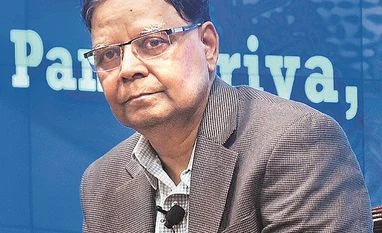 "'UBI fashionable but misguided recommendation,' says Arvind Panagariya")












