Associate Sponsors

Co-sponsor

Unfinished RCEP gets under the skin of nations at Asean business Summit

Proposed trade deal for bloc and six of its freer trade partners, including India, has been stuck on tariffs, services
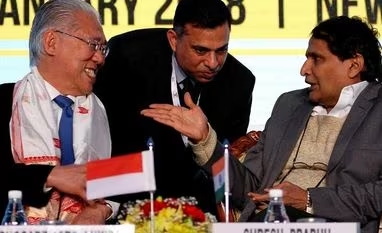
Suresh Prabhu, RCEP, Asean, Enggartiasto Lukita
Commerce Minister Suresh Prabhu (right) with Enggartiasto Lukita, minister of trade for Indonesia, at the Asean-India Business and Investment meet and Expo Promoting Mutual Trade & Investment for Shared Prosperity in New Delhi. Photo: Dalip Kumar
Subhayan Chakraborty New Delhi
Last Updated : Jan 23 2018 | 3:28 PM IST
The long stalemate over the proposed Regional Comprehensive Economic Partnership (RCEP) deal repeatedly came up as a contentious issue on the first day of the Asean-India Business and Investment Meet and Expo here.

On Monday, trade and economy ministers from seven nations in the 10-country bloc alluded to speedy conclusion of RCEP as a necessity. While the Indian government said the sensitivities of all nations — services trade in its case — needed to first be taken into account.

RCEP is a proposed free trade agreement (FTA) between the 10 countries of the Association of Southeast Asian Nations (Asean) and six others with which it has trade agreements — Australia, China, India, Japan, South Korea and New Zealand.

The deal had earlier been held up due to disagreement over eliminating tariffs on goods trade, a subject on which India has come under increasing opposition from the other nations. Now, led by Asean, these countries want that tariffs on almost 92 per cent of all traded goods be reduced or eliminated. 

“I hope India will not disappoint Asean this year in completing the RCEP,” Indonesian trade minister Enggartiasto Lukita told captains of industry from India and Asean.

Asean has pushed for meaningful progress on RCEP before the end of this year — 2018 is the 50th anniversary of its founding. However, India has continued to push back. "So many things are happening. Where is the question of disappointment?” commerce and industry minister Suresh Prabhu said on the repeated negotiations.

Services trade has become the latest big issue in disagreements; India wants liberalisation of rules here and greater market access. This country has large numbers of trained services professionals such as nurses, chartered accountants, information technology professionals and trained workers in several other segments. 

“The rise of the services sector is defining India's growth narrative; this is a common strand between India and Asean,” commerce secretary Rita Teaotia said in the inaugural speech at the event, hosted by business chamber CII.

India had pushed hard for the opening of services trade, especially on Mode 4, on cross-border migration of professionals in the sector. While other nations have historically not been open to the idea, they have started to make discussion on e-commerce a part of those on services, said the official mentioned earlier.

India should be wary of e-commerce norms being imposed on it, owing to the digital platform still in a nascent stage in the country. Within e-commerce, issues such as consumer protection, domestic regulatory frameworks, customs duties and data protection, said Biswajit Dhar, trade expert.

Society groups have voiced concern over possibly drastic reductions in agricultural tariffs, making Indian products uncompetitive, as well as looser investment norms, exposing the country to litigation from foreign commercial interests.

RCEP is expected to be the world's largest regional trading bloc, with nearly 45 per cent of global population and combined gross domestic product of $21.3 trillion.

India's trade with Asean nations was a little more than $70 billion in 2016-17. The bloc is source and destination of more than a tenth of our import and export.

One subscription. Two world-class reads.

Already subscribed? Log in

Subscribe to read the full story →
*Subscribe to Business Standard digital and get complimentary access to The New York Times

Smart Quarterly

₹900

3 Months

₹300/Month

SAVE 25%

Smart Essential

₹2,700

1 Year

₹225/Month

SAVE 46%
*Complimentary New York Times access for the 2nd year will be given after 12 months

Super Saver

₹3,900

2 Years

₹162/Month

Subscribe

Renews automatically, cancel anytime

Here’s what’s included in our digital subscription plans

Exclusive premium stories online

  • Over 30 premium stories daily, handpicked by our editors

Complimentary Access to The New York Times

  • News, Games, Cooking, Audio, Wirecutter & The Athletic

Business Standard Epaper

  • Digital replica of our daily newspaper — with options to read, save, and share

Curated Newsletters

  • Insights on markets, finance, politics, tech, and more delivered to your inbox

Market Analysis & Investment Insights

  • In-depth market analysis & insights with access to The Smart Investor

Archives

  • Repository of articles and publications dating back to 1997

Ad-free Reading

  • Uninterrupted reading experience with no advertisements

Seamless Access Across All Devices

  • Access Business Standard across devices — mobile, tablet, or PC, via web or app

Next Story


