
UP's abattoir shutdown: Butchers, farmers, traders hit while big biz gain
Unable to get a good price, most of the farmers decide to take their animals back home
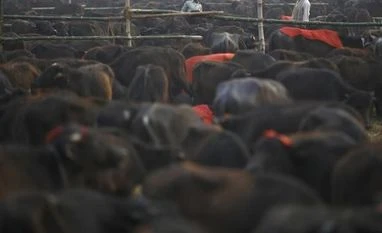 "UP's abattoir shutdown: Butchers, farmers, traders hit while big biz gain")
premium
Explore Business Standard

Associate Sponsors
Co-sponsor
Unable to get a good price, most of the farmers decide to take their animals back home
Mohammad Shafiq took solace from the large grain container placed in a corner of the room. “This will last six to nine months. At least we won’t starve now,” he said.
The 52-year-old, who lives with his family in a small hutment in a graveyard in Kanpur’s Idgah Colony, used to procure meat from the nearby government slaughterhouse and sell it by the roadside.
In March 2017, the newly-elected Bharatiya Janata Party(BJP) government in Uttar Pradesh (UP) ordered action against slaughterhouses and meat-sellers operating without valid licences and violating environmental and health rules.
For a while, Shafiq went back to his ancestral village with his wife and kids. There, he worked as a farm-hand even though his left hand does not function properly. “It was wheat harvesting season. I had never done that work before but with my kids’ support, I managed somehow and got 500kg grain in return,” he told IndiaSpend on a muggy June evening.
Now back in Kanpur, Shafiq hawks churan (tangy powder), tamarind and jamun around town. “Earlier my elder son used to do this work, but he suffers from night blindness. I thought I can put in more hours than him. He has now taken to buying and selling scrap. I make Rs 200-250 a day while he manages between Rs 75-125,” Shafiq said.
Mohammad Shafiq sells churan (tangy powder) in Kanpur, central Uttar Pradesh. Till three months ago, he used to sell meat that he bought from a government abattoir in Kanpur and earned a profit of Rs 500 every day within three hours. With the closure of the slaughter house, Shafiq now hawks his wares till evening and makes Rs 200-250.
From meat-selling, Shafiq used to earn Rs 400-500 within three hours. “The meat, fresh from the slaughterhouse, would sell quickly. We don’t have refrigeration, so I would only buy as much as I could sell easily. Any leftovers, the family would use,” he said.
‘Illegal’ slaughterhouses: Past governments ignored issue
The Prevention and Control of Pollution (Uniform Consent Procedure) Rules of 1999 list slaughterhouses under the ‘red’ heavily-polluting category with potential to adversely impact public health.
In UP, as in the rest of the country, a range of agencies regulate slaughterhouses. Foremost among these is the state-level pollution regulator, the Uttar Pradesh Pollution Control Board (UPPCB), which gives permission (“no-objection certificate”) for setting up a slaughterhouse after getting a go-ahead from the top district administrator, the District Magistrate (DM). The DM conducts a site inspection to assess compliance with various parameters, including law and order, before granting permission. Once a slaughterhouse is set up, the UPPCB monitors its functioning to ensure pollution control measures are in place.
If the facility is for export, approval is also required from the Agricultural and Processed Food Products Export Development Authority (APEDA). Slaughterhouses must also follow the Prevention of Cruelty to Animals (Slaughter House) Rules, 2001, as well as obtain a license from the Food Safety and Standards Authority of India (FSSAI) to ensure all animal-derived food is healthy.
Many slaughterhouses have been accused of violating norms, and the National Green Tribunal (NGT) is hearing a string of petitions seeking their upgradation or closure. In May 2015, hearing one such petition, the NGT ordered all slaughterhouses running without requisite permits in UP to be shut.
When the new BJP government assumed office in UP in March this year, it began to take action on the NGT order.
Both private and government-run slaughterhouses were shut, having failed to upgrade despite the 2015 NGT order, a previous Supreme Court order and reminders by the UPPCB.
In this partial list of 129 industrial units failing to install anti-pollution devices in 2015, 44 were slaughterhouses, 39 of which were run by municipal bodies and nagar panchayats while another was run by the Lucknow Cantonment Board. All four of capital city Lucknow’s slaughterhouses were found not to have proper treatment facilities.
According to the Uttar Pradesh Municipal Corporation Act, 1959, the construction and maintenance of public markets and slaughterhouses is an obligatory duty of the local corporation. The Allahabad High Court upheld this in an ongoing case regarding operation of slaughterhouses.
An amount of Rs 12.5 crore was sanctioned on January 3, 2017, for the modernisation of the slaughterhouse at Lucknow’s Moti Jheel, but the project got stuck when the model code of conduct for assembly elections came into force the very next day.
A similar situation prevails in other cities and towns except Agra, where the municipal corporation runs a modern abattoir.
“The responsibility of previous governments is greater than the current government. They failed to modernise the slaughterhouses for a very long time preparing the ground for the present crisis,” said Irfan Ahmad, the vice-president of the Jamiat-ul-Quresh, an organisation of slaughterhouse owners and meat and beef suppliers in Kanpur.
A comparison of the earnings and expenditures of the Lucknow and Agra municipal corporations shows how the state capital lost precious revenue by failing to modernise its slaughterhouse.
The Agra Municipal Corporation earned Rs 4.26 crore in 2014-15 from leasing out its modern slaughterhouse to a private contractor. The contractor uses the facility for export purposes and also allows individual butchers to use it for a fee of Rs 385 per buffalo. The Lucknow Municipal Corporation, in contrast, was able to charge Rs 10 as fee for slaughtering of goat/sheep and Rs 25 for buffalo, making Rs 25.33 lakh in all. Spending Rs 44.87 lakh on staff salaries, it reported a loss of over Rs 19 lakh.
Source: Budget documents of Lucknow and Agra municipal corporations
A crackdown with wide reverberations
UP, India’s top meat producer in 2012-13, has felt the reverberations far and wide.
Of the 77 APEDA-approved slaughterhouses in India, 44 are in UP. In addition to these, municipal corporations and nagar panchayats (city councils) run numerous abattoirs to meet the domestic meat requirement.
UP has a famous, long-standing non-vegetarian culinary tradition, and as per the 2011-12 consumer expenditure survey of the National Sample Survey Organisation (NSSO), an average UP household reported consuming 0.17 kg of buffalo meat every month, as against the all-India average of 0.10 kg.
Some 30.6% of UP households reported they consumed non-vegetarian food, while 7.95% households reported they consumed beef or buffalo meat. The all-India average was 4.5%.
Already subscribed? Log in
Subscribe to read the full story →

3 Months
₹300/Month
1 Year
₹225/Month
2 Years
₹162/Month
Renews automatically, cancel anytime

Over 30 premium stories daily, handpicked by our editors


News, Games, Cooking, Audio, Wirecutter & The Athletic
Digital replica of our daily newspaper — with options to read, save, and share


Insights on markets, finance, politics, tech, and more delivered to your inbox
In-depth market analysis & insights with access to The Smart Investor


Repository of articles and publications dating back to 1997
Uninterrupted reading experience with no advertisements


Access Business Standard across devices — mobile, tablet, or PC, via web or app
First Published: Jul 15 2017 | 10:28 AM IST

