Why PM Modi chose Nirmala Sitharaman for the finance ministry job

The top job in the finance ministry opened up as Arun Jaitley, who held the position during Modi's first five-year term, made himself unavailable for health reasons
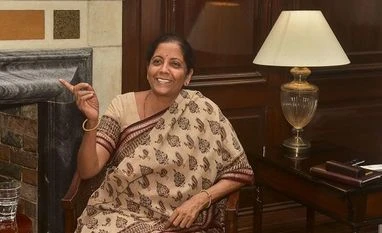
Newly appointed Finance Minister Nirmala Sitharaman takes charge at South Block, in New Delhi
Andy Mukherjee | Bloomberg
4 min read Last Updated : Jun 01 2019 | 8:57 AM IST
Partly by default, and partly by design, Prime Minister Narendra Modi has managed to assemble a newish-looking team for his second term. Hopefully, the freshness will carry over to ideas.

The top job in the finance ministry opened up as Arun Jaitley, who held the position during Modi’s first five-year term, made himself unavailable for health reasons. 
 
The prime minister picked Nirmala Sitharaman to become India's first full-time female finance minister. (1) Sitharaman previously handled defense and commerce but lacks the experience typical for what's traditionally considered the cabinet's No. 2 job, having been a member of parliament for only five years. Several of India's past finance ministers have gone on to become prime ministers and presidents.

So perhaps the prime minister himself wants to be closely involved in supervising the economy. That's good and bad. Decisive leadership is required to unclog the jammed financial channels, speedily privatize state-run businesses, and give private investments a decisive push. The risk with strongmen leaders is that they tend to give short shrift to institutions and independent-minded counsel, something that Sitharaman herself will need to be mindful of when implementing her boss's plans. 

What the new Indian finance minister lacks in heft, she must make up with organizing ability, as a sort of coordinating minister for economic affairs. A signature reform investors expect from Modi's second term is a new labor law – a single, flexible code to replace a plethora of antiquated rules. With Sitharaman as the point person for finance, and Modi keeping a close tab, the labor ministry will be working overtime to deliver a bill. Ditto for land acquisition, a major roadblock for infrastructure and industrial projects, as my colleague Anjani Trivedi wrote recently. The BJP has a comfortable single-party majority in the lower house of parliament, and may gain control of the upper house by next year. That augurs well for a simplified, less-time-consuming law for acquiring and pooling farmland for new purposes, something Modi was unable to carry through in his first term.  

Sitharaman's not-to-do list will be equally crucial. Given how badly India needs risk capital from the rest of the world, one of her priorities will be to rein in an overzealous bureaucracy itching to raid the central bank's reserves. That misadventure, if encouraged, would further emasculate the Reserve Bank. Her other task will be to extricate the government think tank from meddling in GDP statistics, whose quality has recently become a pet peeve of investors.

While Sitharaman as finance minister is a somewhat surprising selection, the most inspired choice in Modi's new cabinet is a non-politician. As a diplomat, Subrahmanyam Jaishankar negotiated with the George W. Bush administration to win US acceptance of India as a legitimate nuclear power. A former ambassador to both the US and China, Jaishankar – as the new foreign minister – can help New Delhi tiptoe around the trade spat between Washington and Beijing. New Delhi has much to gain from a remaking of global supply chains, as well as much at risk from a tech cold war. The digital Iron Curtain, as my colleague Tim Culpan calls it, will be a challenge for the Modi government’s second term. Even as President Donald Trump is determined to isolate Huawei Technologies Co., the Chinese electronics firm is making a strong bid to participate in fifth-generation, or 5G, mobile services in India.

Then there's the broader trade question. China is importing more from other countries to cut reliance on US suppliers. That's helping India slash its annual trade deficit with China by $10 billion to $53 billion. Still, the country's overall trade deficit hit a five-month high in April. Unless the new commerce minister, Piyush Goyal, is able to lift stagnant exports, any revival in domestic demand – or an increase in global oil prices – could destabilize the rupee and derail reforms. Modi's new team has its work cut out.

One subscription. Two world-class reads.

Already subscribed? Log in

Subscribe to read the full story →
*Subscribe to Business Standard digital and get complimentary access to The New York Times

Smart Quarterly

₹900

3 Months

₹300/Month

SAVE 25%

Smart Essential

₹2,700

1 Year

₹225/Month

SAVE 46%
*Complimentary New York Times access for the 2nd year will be given after 12 months

Super Saver

₹3,900

2 Years

₹162/Month

Subscribe

Renews automatically, cancel anytime

Here’s what’s included in our digital subscription plans

Exclusive premium stories online

  • Over 30 premium stories daily, handpicked by our editors

Complimentary Access to The New York Times

  • News, Games, Cooking, Audio, Wirecutter & The Athletic

Business Standard Epaper

  • Digital replica of our daily newspaper — with options to read, save, and share

Curated Newsletters

  • Insights on markets, finance, politics, tech, and more delivered to your inbox

Market Analysis & Investment Insights

  • In-depth market analysis & insights with access to The Smart Investor

Archives

  • Repository of articles and publications dating back to 1997

Ad-free Reading

  • Uninterrupted reading experience with no advertisements

Seamless Access Across All Devices

  • Access Business Standard across devices — mobile, tablet, or PC, via web or app

Next Story


