Green shoots or just an uptick?
Though experts agree the core sector's performance in September is a positive development, most believe it is too early to term it an industrial recovery
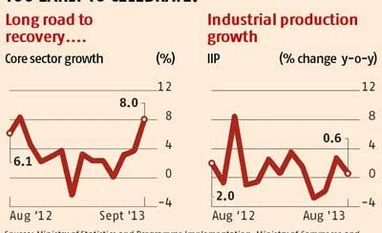
Somesh Jha New Delhi When the core sector numbers for September sprang a surprise by growing at eight per cent, the highest in a year, it was considered a precursor to industrial recovery. This optimism was on the back of double-digit growth in three of the eight infrastructure sectors — electricity (12.6 per cent) , cement (11.5 per cent) and coal (12.5 per cent). The core sectors contribute 38 per cent to the Index of Industrial Production (IIP).
However, experts seem to be divided on whether this is a recovery. Some concede this is indeed a positive development but they warn it is too early to term it as a recovery. “It is a good sign but we need to wait for the growth to remain so for the next two to three months,” said Anis Chakravarty, senior director at Deloitte India.
D K Joshi, chief economist of CRISIL, seconded his views. “The core sector remains volatile and does not mean that this will continue for the next months.”
However, according to Madan Sabnavis, chief economist at CARE Ratings, the numbers do symbolise a first indicator to green shoots because the base of the same month of 2012 was also high (when the core sectors expanded 8.3 per cent). “Had the base been low, we could say this was a result of that but despite a high base, if growth is eight per cent, then it means there is some industrial recovery taking place.”
Sabnavis said the result of government spending on infrastructure was being reflected. This, he pointed out, could be witnessed through bank credit growth as well, which surged in September. The non-food bank credit increased by 18.2 per cent in September, compared to 15.9 per cent growth in the year-ago period.
“This means that industries, both small and large, are raising funds to invest,” Sabnavis added.
On the other hand, some experts said as commercial paper borrowings are costlier, industries are turning to banks to borrow funds. “The reason the credit growth is high is because of comparatively cheaper interest rates through banks,” said Devendra Pant, chief economist at India Ratings.
According to Sabnavis, though interest rates of commercial banks are high, credit growth remains healthy.
Pant is of the view that core sector and IIP data need to be watched for the coming months. “To term it recovery could be misleading.”
This may also be a result of a pre-festive mood, according to Chakravarty. “This may be a seasonal growth — we do not know yet. We have to wait for IIP data for the coming months and there has to be some consistency.”
Pant said this happened last year, too, when core sector expanded at a good clip but not consistently. In September last year, the core sector had recorded an 8.3 per cent growth, the highest since January 2009-10. However, in subsequent months, these infrastructure sectors went up by below five per cent.
Even these numbers were not reflected in the IIP in 2012, as the industrial output contracted 0.7 per cent in September last year. In the previous month, industrial activity remained almost stagnant, as it witnessed a sluggish growth of 0.6 per cent.
Sabnavis said that a lot depended on the private sector, the main driver of growth now. “The finance ministry has consistently said it will not breach the 4.8 per cent fiscal deficit target and, hence, there will be no government spending as such,” he said. The fiscal deficit has already touched 76 per cent of the Budget Estimate in the first half of the year.

 "Green shoots or just an uptick?")


