
NEP a revolutionary reform of 21st Century, will empower youth: Javadekar
He also expressed confidence that India's Gross Enrolment Ratio (GER) would double in the next 10 years from the current level of about 25 per cent
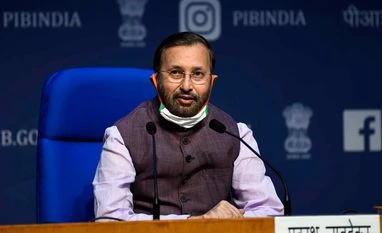 "NEP a revolutionary reform of 21st Century, will empower youth: Javadekar")
Explore Business Standard

Associate Sponsors
Co-sponsor
He also expressed confidence that India's Gross Enrolment Ratio (GER) would double in the next 10 years from the current level of about 25 per cent
Union minister Prakash Javadekar
on Saturday termedthe National Education Policy (NEP) 2020 as a revolutionary reform of the 21st Century.
He also expressed confidence that India's Gross Enrolment Ratio (GER) would double in the next 10 years from the current level of about 25 per cent.
"The NEP 2020 will empower the youth, who will take the nation forward in the 21stcentury.
"The policy is such that it will make the teaching learning experience enjoyable for students and teachers," the Information and Broadcasting Minister said while delivering the key-note address at the centenary year of Teachers' Day celebrations of Parle Tilak Vidyalay Association here via video link.
The GER is a statistical measure used in the education sector to determine the number of students enrolled in school at several different grade levels. It is used to show the ratio of the number of students who live in a given country to those who qualify for the particular grade level.
Javadekar said students across the country have become aspirational while the economic growth has pushed the parental earnestness to provide good education for their wards.
"Wider geographical spread of higher education institutions, especially covering rural areas, and increased demand would be the critical factors that will improve the GER in India," Javadekar said.
He said the NEP lays emphasis on foundational and numerical literacy, and that institutes like National Institute of Open Schooling (NIOS) would give access to all for education.
Javadekar added that (aspects like) early childhood education; enquiry-based education; teacher training; foundational and numeric literacy etc have been emphasised (in the NEP 2020).
The NEP, approved by the Union cabinet in July this year, outlines the vision of India's new education system.
The minister further underlined the importance of early childhood education as the main characteristic of the NEP.
He said the age group of 3-8 years is to build cognitive skills, curiosity and mental capacity.
He added that education with understanding of the given subject is important rather than rote learning.
While activity-based learning is emphasised at the early age, education imparted during classes 9 to 12 would focus on "detailed, relevant and new knowledge", which will induce scientific temper among children, Javadekar said.
He also said research and innovation is crucial "to enabling our education mould globally competitive citizens".
(Only the headline and picture of this report may have been reworked by the Business Standard staff; the rest of the content is auto-generated from a syndicated feed.)
First Published: Sep 05 2020 | 5:31 PM IST

