“No written word or spoken plea can teach young minds how they ought to be; nor all the books on all the shelves but what the teachers are themselves”
— Rudyard Kipling
A single child with a single parent, growing up in Lucknow in a joint family, Gaurav Singh, now 33, had a linear upbringing that allowed him to look at only two serious career options: an engineer or a doctor. A bright student, academics came easily to the 10-11-year-old who often ranked among the top in his class in school. His mother – who he affectionately refers to as Jhansi Ki Rani - was often told that her son had real potential and that he could simply walk into an IIT after school and end up with a great job that paid him handsomely. The passport and all drivers for success: a good job, a wife, a house and a big car to drive – lay well within his grasp.
But as Gaurav approached his teenage years, he began to question what he was doing here on earth and what the purpose of life was, unusual preoccupations for a 13-year-old but there it was. He didn’t want to go to IIT just because he could. The prospect of owning a big car didn’t move him. He couldn’t care less about house ownership. A job in some MNC and a wife sounded even less alluring.
As the years went by, Gaurav began to study less, appeared less and less motivated and performed far below what was expected of him and what he was capable of. “There goes lost potential” is what people in the wider family and community around him began to say.
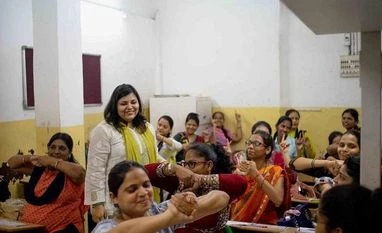
321 foundation is focused on working with teachers in schools to help them teach better
For a few years, all did appear lost, especially to his mother who had nurtured the boy with love and careful attention to his every need. She began to question where she had possibly gone wrong. Why were all threats or rewards not enough to motivate her bright spark of a son? He appeared to have great potential; yet he seemed set on squandering it away. Nothing seemed to motivate him or hold his attention.
Gaurav says his only hope at that stage were books and that’s what saved him. He himself didn’t have any answers but he knew that the conventional path did nothing for him. “I was happy to do something but I wanted something meaningful and no one around me could understand what I was harping on about”. He says he spent all those years “disappointing” everyone who mattered the most to him. “None of the usual drivers cut it for me”.
With his state of mind, IIT was a far cry but he did head to the cool climbs of Himachal to do an engineering degree at a private college. Although Gaurav continued to perform quite mediocrely at his studies, he spent hours teaching his fellow students. He was always more intrigued by how best to explain a concept to a peer than studying his own books and performing well. “I would spend hours teaching my peers subjects that they were struggling with while almost failing mine!”, says he.
Gaurav finished his studies and joined Accenture in Hyderabad as a coder. Again, he was less than excited about his job although he didn’t mind the actual work. His friends – several of whom envied his position and would give anything to be there – often commented on how indifferent he seemed, at times making him feel guilty about not appreciating what he had.
“Look at how things have changed for doctors in 100 years and how they have changed for teachers. A black board became a white board but what else? Doctors on the other hand have no end of tools, machines and technology at their disposal”, he argues. Teachers he feels have largely been left to their own devices and are expected to perform a miracle out of nothing.
Second, he feels that unlike many other professions, there are no accepted or established best practices that teachers can draw upon. “They are expected to figure out everything on their own while everything remains the way it did 50 years ago”, he adds. The profession remains poorly paid and women dominated. “If it was remunerative, there’s no reason why more men and women would not become teachers instead of bankers or lawyers”, he points out. The third thing he was convinced is that whatever improvements were brought in had to be scalable over time. To reach every teacher and student over a period of time, which was unlikely to be within his lifetime but a start nonetheless.
He also wanted to set up an organization – a great place to work – where his own employees could feel they were having an impact and that they were having fun doing it. He wanted people to join in their 20s and work through till their mid 50s not join the education space in their mid 50s after they had more or less concluded their professional lives. “I didn’t want everyone joining to give back to society as we so often see. I wanted them to love what they were doing right from the word go”, he says. “I didn’t want people to look back and say: we had great impact but it was a horrible journey”, says Gaurav.
That’s when the idea of 321 came to him. Set up as a foundation, 321 are focused on working with teachers in schools to help them teach better. There are 3-4 foundational principles that 321 uses to differentiate what it does from all the other thousand-odd NGOs who work on the same thing.
321 foundation is focused on working with teachers in schools to help them teach better
In its seventh year now, 321 currently works with teachers across 130 schools in three cities as of now: Mumbai, Hyderabad and Bangalore. This year the organization is working with around 2500 teachers. A second programme has been started where 321 is supporting the curriculum. This is only just begun and is being run in four schools as of now. The organization has been funded by mainly grants, foundations (40 per cent of the money) and CSR funds (another 40 per cent). Ashish Dhawan is the chair of the board and has been supporting Gaurav’s work from the word go. Schools also pay a small amount depending on their capacity.
Moreover, 321 as an organization has a 90 per cent retention rate, the team that has grown from 7-8 people to around 75 now has an average age of 25 to 27 years. The Mumbai headquartered team therefore brings all the energy that only 25 year olds can and Gaurav infuses this energy with his own to prove that his real potential is yet to emerge fully. He’s finally found something worth his while though.

 "Teaching the teachers: The Lost And Found Potential Of Gaurav Singh")












 Connect with us on WhatsApp