The Aam Aadmi Party’s comprehensive victory in the Delhi election is not necessarily a mandate for a left-leaning, welfare dole-based economics, and the results are not likely to lead to competitive populism between Kejriwal and the Narendra Modi government at the Centre, experts say.
In the 2014 Lok Sabha elections, when the Bhartiya Janata Party (BJP) got the most decisive parliamentary majority in 30 years, many viewed it as a victory for right-leaning economic thought, with emphasis on free market capitalism, higher private spending, curbed subsidies and lower tax rates, over the left-of-centre school of thought, market by welfare schemes, increased subsidies and other populist measures, and massive government spending.
This view was backed by the fact that Modi had campaigned with promises of jobs, infrastructure, and economic development, rather than doling out freebies. Back to the present, and with the AAP promising cheap electricity and free water, among other things, is there a possibility that populism is back? Economists think otherwise.
“The premise that the Delhi elections were about populism is not entirely correct. Maybe partially it was a factor but a majority of the voters seem to have taken note of other issues like corruption and safety. Corruption seems to be the biggest issue that resonated with voters this time,” said N R Bhanumurthy at the National Institute of Public Finance and Policy.
He said the government at the Centre had not shied away from public welfare schemes and initiatives like the Pradhan Mantri Jan Dhan Yojana and Direct Benefit Transfers were necessary. “The way the government goes about its economic policymaking will not change drastically after this result,” he said.
“The people of India or any of the states have never voted for any particular economic school of thought. They vote for more particular issues,” said Arun Maira, member of the erstwhile Planning Commission. “This line between the right and the left school of economic thoughts is created by the media and the intellectuals.”
He noted the Modi government had never once suggested cutting on subsidies but on better targeting. So, he felt, the Delhi results would not compel Modi and Finance Minister Arun Jaitley to curb reform measures in lieu of bigger populist schemes.

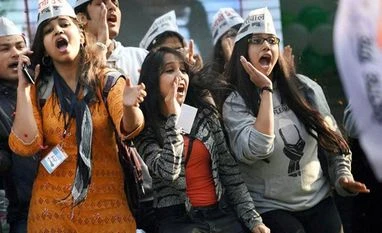 "AAP win unlikely to mean competitive populism")


 Connect with us on WhatsApp