'Kalank' lays out a beautiful world that unremarkable story doesn't deserve

The film feels like it was visualised on a digital storyboard but not read on paper as a coherent script
weekend
Kalank exploits the standard conventions of beauty
Veer Arjun Singh
4 min read Last Updated : Apr 19 2019 | 10:34 PM IST
Every festival in fictitious Husnabad of the 1940s is celebrated with such enthusiasm that the streets get jammed with dancers in bright costumes as far as the eye can see. Abhishek Varman explores the depth of set designs so well that it would have been easy to lose oneself in Kalank, his second film after 2 States, had it not been for its myopic grandeur.

The film feels like it was visualised on a digital storyboard but not read on paper as a coherent script. Husnabad is part Lucknow and part ancient Greece. It reminds you of Bajirao Mastani and Devdas (the one that released in 2002), but its closest competitor in Sanjay Leela Bhansali’s filmography is Ranbir Kapoor and Sonam Kapoor’s 2007 debut Saawariya. However, unlike Bhansali, who is the master of climactic tragedies in drop-dead gorgeous settings, Varman, despite having the backing of a solid cast, fails to evoke even sympathy for his dying characters, forget a steady stream of tears.

At two hours and 50 minutes, Kalank exploits the standard conventions of beauty. Cinematographer Binod Pradhan does a tireless job of carrying the heavy burden of a lackadaisical story with beautiful close-ups of costumes and jewellery, which would soon be looking for an auction.

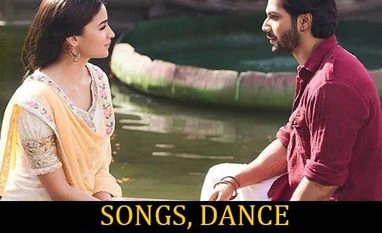
Varman, on the other hand, exploits the conventions of a timeless Indian tragedy. An illegitimate child, Zafar (Varun Dhawan) — born out of the unrequited love of a courtesan, Bahaar Begum (Madhuri Dixit) and a stately businessman, Balraj Chaudhary (Sanjay Dutt) — is an ironsmith and a man of the streets. Roop (Alia Bhatt), his love interest, is instead married to his half-brother and Chaudhary’s son, Dev (Aditya Roy Kapoor), in a compromise forced on both by Dev’s first wife, Satya (Sonakshi Sinha), who’s dying of what appears to be cancer. No tears there or anywhere. The story spells out the title, Kalank, ad nauseam, with every sequence.

Varman was shooting for a cult classic. And the universe he creates with a fabulous cast and elaborate settings was conducive for it. Dialogues, not spoken, but sung in prose, are impactful. But they can be easily taken out of context if the audience is not invested in the story. There’s a thin line between quotes and memes. In Roop’s words to Zafar, “Tum koi baat seedhi kyun nahi kehte (why can’t you be direct?)”, is going to cost Karan Johar and his ensemble of producers dearly.

While Kalank invites ruthless criticism for its script, it also deserves plentiful praise for its performances. Bhatt brings to Roop the jovial energy and childish innocence that has become a staple of her age-appropriate roles, but she does it with an extra tinge of maturity that the character demands. She deserves the applause, but it’s not her film this time. It is Dhawan’s entry to the serious business of acting. Zafar’s kohl-rimmed eyes express his myriad emotions with distinction.

For Dixit, it’s another role of a courtesan gone to waste. She’s as expressive and statuesque as ever, but her limited screen time can’t lift the film. Kapoor as Dev, an upright editor of a national daily, is an astute actor capable of emulating natural tears. And Dutt, a cigar-smoking, deviously classy patriarch, stays convincingly true to being a man of many regrets.

Together they star in a film that makes their collective tehzeeb (demeanour) preachy. It is ironic how its dialogues appropriately adjudicate the film. In Begum’s words, “Shukriya taareef ka nahi badnami ka karna chahiye (Thank the disrepute not the praise).” The film deserves admiration for the attempt, but I doubt any constructive criticism will go down well with the producers who have spent several crores on it.

While the film is well on its way to recover the cost, Kalank is unlikely to leave any mark whatsoever on the minds of Bollywood’s faithful audience.

One subscription. Two world-class reads.

Already subscribed? Log in

Subscribe to read the full story →
*Subscribe to Business Standard digital and get complimentary access to The New York Times

Smart Quarterly

₹900

3 Months

₹300/Month

SAVE 25%

Smart Essential

₹2,700

1 Year

₹225/Month

SAVE 46%
*Complimentary New York Times access for the 2nd year will be given after 12 months

Super Saver

₹3,900

2 Years

₹162/Month

Subscribe

Renews automatically, cancel anytime

Here’s what’s included in our digital subscription plans

Exclusive premium stories online

  • Over 30 premium stories daily, handpicked by our editors

Complimentary Access to The New York Times

  • News, Games, Cooking, Audio, Wirecutter & The Athletic

Business Standard Epaper

  • Digital replica of our daily newspaper — with options to read, save, and share

Curated Newsletters

  • Insights on markets, finance, politics, tech, and more delivered to your inbox

Market Analysis & Investment Insights

  • In-depth market analysis & insights with access to The Smart Investor

Archives

  • Repository of articles and publications dating back to 1997

Ad-free Reading

  • Uninterrupted reading experience with no advertisements

Seamless Access Across All Devices

  • Access Business Standard across devices — mobile, tablet, or PC, via web or app

Next Story



