Banks set for lending rate action this week
SBI, IDBI Bank among a host of lenders holding asset-liability panel meets
Abhijit LeleNupur Anand Mumbai Days after the Reserve Bank of India (RBI) lowered the repo rate in a surprise move, banks have set the ball rolling for a possible reduction in their lending rates.
Repo is the rate at which the central bank lends to commercial banks.
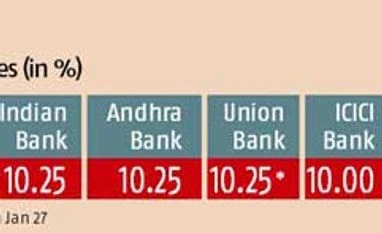
A host of lenders, including State Bank of India (SBI), IDBI Bank, Indian Bank and Andhra Bank, have lined up meetings of their asset-liability committees (Alco) this week, to review their lending and deposit rates.
“We will review it next week, though the date for the Alco meeting is yet to be fixed,” said B Sriram, managing director (National Banking Group) at SBI, the country’s largest lender.
Amid sluggish credit growth, many banks have already reduced their deposit rates for select maturities, during the October-December period, following a comfortable liquidity situation. As a result, the cost of funds has come down, albeit marginally. For instance, in the December quarter, SBI reduced its deposit rate by up to 50 basis points.
Along with lending rates, banks are likely to reduce deposit rates as well, to protect margins. “We have an Alco meet this week. Besides lending rates, deposit rates also need to come down. So far, there has been a minor correction in some maturities but we will now take a closer look at the rates,” said M S Raghavan, chairman & managing director, IDBI Bank.
With tepid credit growth, banks have been flush with excess liquidity, so deposit rates have begun to come down. SBI, which had Rs 70,000 crore of excess liquidity during December, has been trimming its deposit rates.
A senior SBI executive said the bank continued to carry a huge surplus till now (mid-January) and the statutory liquidity ratio (SLR) was about five per above the floor rate of 22.5 per cent. “We have reduced deposit rates since the September quarter and were expecting other banks to also do so. But their rates continue to be high.”
Amid decelerating credit demand, loans in September 2014 grew at their slowest pace in a decade. According to the latest RBI data, year-on-year bank credit growth this financial year (as on December 26) was 10.5 per cent.
A section of private and public-sector lenders believes if SBI lowers rates, others will follow suit. SBI’s base rate — the benchmark with which all its loan rates are linked — stands at 10 per cent.
A few bankers, however, deny they will come under peer pressure; a decision to reduce the base rate is a function of cost of funds, they say.
"We will review rates in the coming week. Though incremental cost of funds has come down in the December quarter, there will be a time lag between the decisions of RBI (repo rate cut) and the bank. But no peer pressure will be at work," said a senior executive of Chennai-based public-sector lender Indian Bank. The bank's base rate is 10.25 per cent.
Two other public-sector banks —Mumbai-based Union Bank and Kolkata-based United Bank — have already reduced their respective base rates by 25 basis points each, to 10 per cent, following RBI's repo rate cut last Thursday. Union Bank has also reduced its interest rates on retail and bulk deposits for certain maturities by 10-50 basis points.

 "Banks set for lending rate action this week")


 Connect with us on WhatsApp