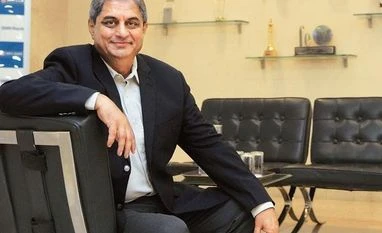
HDFC Bank’s lobby, boardrooms and meeting rooms are all adorned with gleaming trophies of awards that the bank has earned since its inception. And the banker who has been spearheading this success is Managing Director Aditya Puri, who has helmed the bank since its founding in 1994.
Puri, the longest-serving head of an Indian bank, has managed to secure HDFC Bank’s position as the second largest private sector lender in terms of assets after ICICI Bank. However, its market capitalisation of Rs 3 lakh crore is 50 per cent more than that of the State Bank of India (the country’s largest bank) and twice that of ICICI Bank. Even more remarkably, it ranks third in the list of most valuable stocks on the Indian bourses, after Reliance Industries and Tata Consultancy Services.
Predominant among HDFC Bank’s many achievements has been maintaining one of the lowest non-performing asset levels amongst its peers, and this despite having a lion’s share in the unsecured lending segment — personal loan and credit cards.
After the 2008 downturn, when unsecured lending was perceived as a risky business by its competitors, HDFC Bank continued to aggressively grow this portfolio. Unlike several other private and foreign lenders, its asset quality remained stable, as the bank has always been offering the bulk of its credit cards to customers with whom it has already established banking relationships. The bank is the largest issuer of credit cards in the country, with close to eight million cards, and a market share of over 30 per cent in number of cards.
Also, at a time when profit growth at most of its private and public sector peers has either slipped to single digits or into negative territory in the last few quarters, HDFC Bank has consistently managed to grow net profit at 20 per cent year-on-year, despite the slow growth of credit demand in the banking system.
Considered largely a retail bank, it has gradually begun increasing its focus on its corporate book. This comes at a time when other lenders have been shying away from offering corporate credit. Earlier, the bank’s main focus within corporate credit used to be working capital loans, but now it has also begun focusing on term loans. In the past three years, the mix has changed and now term loans contribute about 25-30 per cent of the book, compared to the earlier 10-12 per cent.
To ensure that bad loans are kept under check, the lender first ensures that it has a relationship on the working capital front before going in for a big investment such as term loans. Going ahead, despite the increased focus on the corporate book, Puri is confident of maintaining asset quality.
At the end of the July-September (2016) quarter, the bank’s gross non-performing assets (NPAs) amounted to 1.02 per cent of gross advances, against 1.04 per cent in the quarter ended June and 0.91 per cent at the end of the September quarter last year. Net non-performing assets were 0.3 per cent of net advances at the end of the September quarter last year.
The other area where the bank has enjoyed a first-mover advantage and that has helped cement its retail portfolio better is rural credit growth. Puri was early to spot the opportunity in this untapped market ahead of his peers. A majority of HDFC Bank’s branches — 54 per cent — are now in semi-urban and rural areas.
The bank now believes that it can gain an even larger share of the semi-urban and rural markets because of digitisation, a potential growth driver for the hinterland. Puri believes that adoption of the digital route will also lead to reduction in the cost of funds. As a result of this digital drive, in the long run the bank will see improvement in both top line and bottom line. Over the next three years, its cost-revenue ratio is expected to decline by 200-300 basis points.
On a trip to Silicon Valley two years ago, Puri realised that disruption in the banking space was inevitable. Returning, he discovered that HDFC Bank had all the ingredients to make the most of it, as it had the customers, as well as the technology of data warehousing and analytics, which can yield a better understanding of retail consumer behaviour. It could ride on these ingredients and build applications that could make sales, credit and operating processes seamless.
It was then that the bank’s transformation journey into a digital bank began and it started working on the mantra of “Think money, Think HDFC Bank”. As a part of this, the bank has launched several products in the digital arena and its mobile and net banking products allow consumers to coduct over 200 transactions. Some of these transactions include applying for a personal loan, credit card, top-up loans, open fixed deposits, transact by linking demat account, etc. Innovations include a “10-second” loan, design your own loan against securities, loans at ATMs, etc.
Though Puri doesn’t use a mobile phone, he has managed to drive the bank’s digital and mobile banking strategy. His mantra of work-life balance — not using a watch or mobile, leaving office at 5:30 pm and spending time with his family — is something that several other CEOs of India Inc have tried to emulate.
Over the years, as competition in the banking space has increased, it has disrupted several dynamics in the banking arena but Puri, who says he likes disruption, has emerged unscathed.