The Reserve Bank of India (RBI) is likely to maintain status quo in its third bi-monthly monetary policy on Tuesday, considering the recent flare up in inflation, said all the 10 economists polled by Business Standard.
Most economists said Tuesday’s policy, also the last by current governor Raghuram Rajan, could remain silent on important reforms measures but may reaffirm issues like the need for continued liquidity and RBI’s preparedness to meet the redemptions of foreign currency non-resident (FCNR-B) deposits worth $20 billion.
Inflation, by far, could remain the central focus of the policy. The past two readings of the inflation have surprised analysts and they don’t expect any let up in July and August too because of unfavourable base effect.
CPI inflation was at 5.77 per cent in June, same as May’s 5.76 per cent.
Even as monsoon turned out to be good, and kharif sowing pattern showed improvement over the previous year, it will take at least a quarter before the products would be able to bring down food price inflation and RBI won’t be in a mood to cut rate before seeing softer numbers, at least not as long as the monetary policy framework continues to target 4 per cent plus/minus 2 per cent for inflation.
“Both the Q1 and Q2 inflation readings have overshot RBI’s projection. And if the same inflation target is retained by the monetary policy committee (MPC), there would be no room for the RBI to cut rates unless one more round of huge drop in oil prices happen,” said Indranil Pan, chief economist of IDFC Bank Ltd.
All economists in the poll said there could be room for a further 25 basis points rate cut, but that would be not before the third or fourth quarter of the fiscal, if at all.
The participants said they would be carefully watching out the RBI’s prediction on inflation and if there was a change in the numbers given the recent spurt in prices. Two important considerations on inflation front would be weighed by the analyst community – the impact of goods and services tax and the impact of deferment of some allowances awarded by 7th Pay Commission.
According to them, services related inflation could shoot up after the implementation of the new tax code, but will get nullified only after sometime when manufacturing prices come down because of GST.
RBI is expected to discuss about the impact of GST in its monetary policy.
Aditi Nayar, senior economist of rating agency Icra Ltd said it would be interesting to see how the deferment of some pay commission recommendations would alter RBI’s view on inflation.
Upasna Bhardwaj, economist of Kotak Mahindra Bank said the RBI would not want to tinker with its rates before getting more clarity on the MPC and the inflation target the body would eventually set for the next five years.
Already there are talks that the inflation target should be revised up from the base of 4 per cent to 5 per cent. If the target is revised, RBI gets more room to reduce rates.
State Bank of India’s Chief Economist Soumya Kanti Ghosh said RBI’s guidance on FCNR (B) related redemptions and the impact on the local currency would be interesting to watch out for. On top of that, how RBI will continue to support liquidity in the system, which is now at a surplus mode after years of remaining in deficit, would be important issues in the policy.
“The policy could be dovish, but the language related to what RBI perceives of the global oil prices and global growth would be interesting read,” Ghosh said.
Most economists said Rajan could simply remain non-committal about the future monetary policy stance, considering in a month he would be demitting office.
However, Rupa Rege-Nitsure, Group Chief Economist with L&T Finance Holdings expected Rajan to be vocal in the policy on a number of issues.
“Dr Rajan will come out with tightly structured arguments based on rich empirical evidence to defend the current inflation target of 4% plus/minus 2% and how any dilution can create risks for macroeconomic stability,” Nitsure said, adding, “’he will also defend the initiation of asset quality review for banks and provide reasons as to why this should continue without any breaks in the interest of financial stability. He would also like the next regime to insist on further deleveraging of large corporates, as the process is still incomplete.”

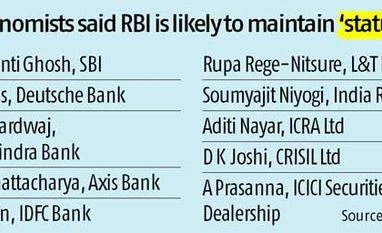 "BS Poll: Rajan may opt for status quo on rate")


 Connect with us on WhatsApp