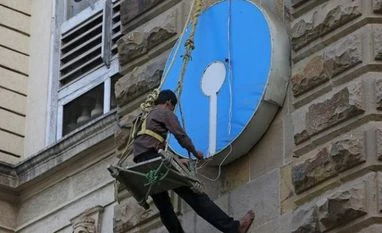
Taking forward the consolidation agenda, State Bank of India (SBI) may merge its five associate banks and Bharatiya Mahila Bank (BMB) with itself to emerge as a financial behemoth, with assets worth Rs 37 lakh crore ($550 billion).
Its five associates are State Bank of Bikaner & Jaipur (SBBJ), State Bank of Hyderabad (SBH), State Bank of Mysore (SBM), State Bank of Patiala (SBP) and State Bank of Travancore (SBT). BMP, started in 2013, is a Delhi-based public sector lender.
SBI chairman Arundhati Bhattacharya said it was a good move and would consolidate the group. “Besides making us more efficient, it will be of huge value. The group will have the benefit of all synergies. Also, the associate banks have fixed assets of around Rs 4,000 crore, which will add to the capital,” said Bhattacharya.
Bhattacharya also added: “After the merger, cost-to-income ratio will come down by 100 basis points in a year. The cost of funds should come down sharply and there itself we will have quite a bit of benefit.”
SBI is likely to complete the consolidation as quickly as possible. “We ideally expect to have combined balance sheet for financial year ending 2016-17,” she told Business Standard. She would demit office in September 2016, on completion of her tenure.
On a standalone basis, the bank has a balance sheet of Rs 28 lakh crore and this will grow to Rs 37 lakh crore after consolidation, she said.
“We will have to work out the scheme of merger and that will mean negotiations with the employees and officers of those banks,” she added.
The stock markets seemed to have welcomed the consolidation move. The SBM stock surged 12 per cent to close at Rs 426, SBT by 10 per cent to Rs 399 and SBBJ by four per cent to Rs 508. However, the SBI stock closed flat at Rs 177 per share. According to Bloomberg’s list of world’s top 50 banks (in terms of assets) after consolidation, SBI ($550 billion) will move up six notches to 44, overtaking Natixis ($544 billion). The top bank on the list is the Industrial and Commercial Bank of China ($3,423 billion).
The consolidation move invoked immediate adverse reaction from trade unions. Opposing the proposed move to merge associate banks with SBI, the All India Bank Employees’ Association has called a strike on May 20.
Commenting on the largest possible consolidation activity in the Indian financial sector, Ashvin Parekh, managing partner at Ashvin Parekh Advisory Services, said, “For the past 15 years, they have been talking about consolidation. It is not a luxury any longer.”
SBI, in its filing with the stock exchanges, said it was seeking "in-principle sanction" from the central government to enter into negotiations with subsidiary banks to acquire their businesses, including assets and liabilities. The government owns 61.32 per cent of the country's largest lender.
A senior SBI official said the decision to consolidate was driven by the government and there was a flurry of activity in the last few days to prepare and propose the decision in Tuesday's board meeting.
However, SBI said the decision was purely exploratory at this stage and there was no certainty to it completing the acquisition. It said intimating the stock exchanges was a matter of good corporate governance to ensure complete transparency. SBI had merged State Bank of Saurashtra in August 2008 and later State Bank of Indore in August 2010.
The decision on the merger will be taken by the bank's board upon evaluating all the relevant considerations, discussions with stakeholders and regulators' nod. Bhattacharya said the swap ratios for the merger would be worked out by two valuers and a third to certify the process.

 "Govt chooses SBI to kick off bank merger")


 Connect with us on WhatsApp