The Reserve Bank of India (RBI)’s move to ease classification of Tier-I capital of banks and include revaluation reserves, deferred tax assets and other items had limited effect on the banks’ Tier-I capital ratio for the March 2016 quarter (Q4). ICICI Bank, Union Bank, Oriental Bank of Commerce (OBC) and Punjab National Bank (PNB) have seen a favourable impact of 90 basis points (bps), 55 bps, 40 bps and 30 bps, respectively, on their Tier-I capital (as declared in Q4) after this easing. The information is based on disclosures by their managements in various media and analyst interactions. A hundred basis points is one percentage point.
RBI recently allowed banks to revalue their fixed assets (including real estate) on the basis of pre-defined guidelines and to reflect the increase/decline in the value of such assets in the revaluation reserve in their balance sheets. Such a move was seen as helping banks prop up their Tier-I capital, making their balance sheets look healthier.
Tier-I capital, in turn, is largely the shareholders funds (owned capital) of a bank, which includes capital invested by shareholders, convertible preference shares, share premium received, retained profits, etc minus any accumulated losses as well as amount of revaluation of assets among a few others. Currently, RBI mandates that banks should have a minimum Tier-I capital of seven per cent and total capital adequacy of nine per cent. Capital adequacy reflects the bank’s financial strength, and is expressed as a percentage of capital to risk-weighted asset.
In case of OBC, some gains have also accrued from infusion of capital by the government as well as Life Insurance Corporation. Bank of Baroda (BoB), which witnessed a sequential uptick of 122 bps in Tier-I to 10.8 per cent, has also benefited from government funding.
P S Jayakumar, managing director and CEO of BoB, said in a post results interaction with media: “Our capital adequacy has improved due to three reasons. One was the Rs 1,786-crore capital infusion by the government in September. Secondly, the foreign currency translation reserves and thirdly, the revaluation of the fixed assets following RBI’s new rules.”
For ICICI Bank, Alpesh Mehta, banking analyst at Motilal Oswal Securities, estimates that the bank has taken full benefit from deferred tax assets and revaluation reserve adjustment leading to a 90 basis points accretion to its Tier-1 capital.
While many banks have not disclosed the gains arising specifically from this easing, a look at the sequential movement in Tier-I ratios of banks gives some insights. Of the 32 banks where Q4 and FY16 data is available, 10 banks have witnessed 100 bps or more sequential increase in their Tier-I capital. These include Bank of India, Bank of Baroda, ICICI Bank, Kotak Mahindra Bank, Axis Bank, Dena Bank and Allahabad Bank, among others.
Another 15 banks have seen less than 100 bps uptick in this metric. Within this, eight banks - HDFC Bank, Canara Bank, IDBI Bank, Union Bank of India, State Bank of India (SBI), Bank of Maharashtra, South Indian Bank, and DCB Bank - have witnessed zero to 50 bps uptick in their Tier-I ratios. Notably, SBI is yet to revalue its real estate. But, the bank management expects an 85-bp addition to its Tier-I capital from such revaluation. Some other banks are yet to include revaluation reserves in their capital so far.
Of the rest, seven banks have witnessed a sequential decline in their Tier-I ratio ranging between 11 bps to 74 bps. These include banks such as Karur Vysya Bank, IndusInd Bank, Jammu & Kashmir Bank, Federal Bank, Punjab National Bank, YES Bank and Corporation Bank.
Overall, despite the exercise, public sector banks still seem crunched for capital. A large part of their operating profits have gone towards provisioning for bad loans – leading to huge losses at the net profit level for most of them. Apart from meeting Basel-III capital requirement norms, these banks will find it difficult to grow their books or even provide more for higher asset quality stress, given their tier-1 capital, say analysts.
Among the 32 banks for which data is available, Indian Overseas Bank, Syndicate Bank and Corporation Bank have the lowest Tier-I capital ratio ranging between 7.75 per cent and 7.93 per cent. In contrast, IDFC Bank, Kotak Mahindra Bank and City Union Bank enjoy the highest Tier-I capital ratios between 15 per cent and 21.5 per cent.

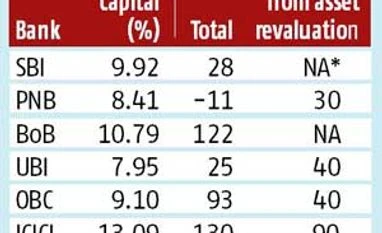 "Marginal gain in banks' Tier-I capital from Reserve Bank's easing")


 Connect with us on WhatsApp