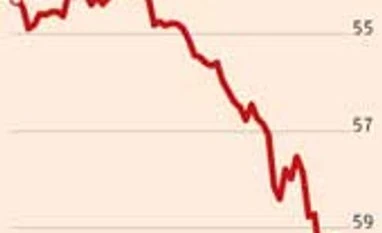
The rupee weakened on Monday due to dollar buying by foreign banks and oil importers’ month-end demand for the greenback. The Reserve Bank of India (RBI) sold dollars via public sector banks to stem the volatility. The market sees the rupee to weaken further and may touch a new all-time low.
The rupee, which opened on Monday at 59.57 a dollar, ended at 59.68, compared to the previous close of 59.27. During the day, it touched a high of 59.54 and a low of 59.82. Earlier, this month, rupee had touched an all-time low in intra-day trades at 59.98. “The rupee weakened due to dollar buying by foreign banks on account of foreign institutional investors (FIIs) pulling out of domestic markets and buying of dollar by public sector banks to meet the demand of oil importers,” said Sandeep Gonsalves, forex consultant and dealer at Mecklai & Mecklai.
The fall in rupee also resulted in bond yields rising. Yields rose posting their worst weekly loss in nearly a year as FIIs sold heavily. The yield on the 10-year benchmark government bond 7.16 per cent 2023 ended at 7.52 per cent against the previous close of 7.43 per cent. In June, FIIs have pulled out $4 billion from the domestic debt.
The outlook for the rupee continues to be weak. Samiran Chakraborty and Priyanka Kishore of Standard Chartered Bank said in a note to clients that technically, the immediate resistance for dollar-rupee is at 63. They also foretaste dollar-rupee at 60.50 at the year-end. The factors responsible are continued dollar strength on the back of Fed tapering expectations and the risk of persistent outflows from Indian markets, which may overshadow the initial improvement in trade deficit expected in third quarter, and a low probability of strong policy measures to stem rupee losses, the note said.
According to dealers, RBI intervened in the market on Monday to arrest volatility. But, there are concerns on RBI’s intervening in a scenario when forex reserves are depleting.
A note by Indranil Sen Gupta, Indian economist, Bank of America Merrill Lynch, estimated how much, out of the forex reserves, RBI can sell to support the rupee. He said, “$30 billion, by our stress tests. But every dollar sold will only breed further doubt about adequacy of foreign exchange reserves. After all, this will further pull down import cover to six months, last seen in the early 1990s, from seven months now. As every round of foreign exchange volatility costs $15-20 billion, RBI has barely enough to tide over, say, a year, in our troubled world.”
A few experts see the rupee strengthening by end of the financial year. Crisil Research expects it to strengthen and settle at 56 a dollar by end-March 2014. “The appreciation will be driven by resumption of FII inflows, which in turn, will be led by two factors. First, the current capital flight from India is a short-term phenomenon and largely in response to the uncertainty surrounding impact of the Federal Reserve’s pullback of quantitative easing. Second, the government is pledging a slew of domestic policy reforms to shore up domestic and foreign investor sentiments,” said Dharmakirti Joshi and Dipti Deshpande of Crisil Research in a report.

 "Month-end dollar demand puts pressure on rupee")


 Connect with us on WhatsApp