The big boys of India Inc need not lose their sleep over the Reserve Bank of India's (RBI's) latest 'capital control' diktat that companies would require prior approval for any direct investment abroad that exceeds their net worth. The reason: The recent surge in their balance sheet means these restrictions will have little impact on them.
Reliance Industries, for instance, can still go ahead and do a $30-billion acquisition without having to seek RBI's approval, while Tata Motors can close a $6-billion deal without visiting Mint Road.
Investment bankers agree. "The 100 per cent cap is more than sufficient for large companies, as they have greatly enlarged their balance sheets in recent years. The limit might pinch smaller companies. But they were anyway not looking to grow outside India," says Motilal Oswal Investment CEO Ashutosh Maheshwari.
Over the past three years, the combined net worth of BSE-200 firms (excluding banking and financial ones) has risen at a compound annual growth rate (CAGR) of 14.6 per cent. As at the end of FY13, it had reached $316 billion, giving these companies sufficient firepower to pursue selective overseas merger & acquisition (M&A) opportunities. Three years ago, the total figure was $210 billion (based on exchange rate of Rs 60 a dollar).
At the end of FY13, half the BSE-200 firms (74 out of 156; ex-banking & financials) had a net worth of Rs 5,000 crore or more, compared with a third (53) three years ago.
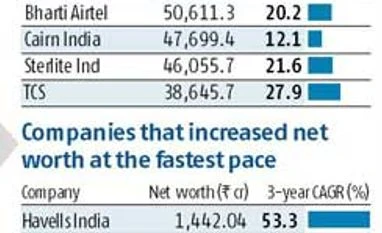
Many fast-growing companies have reported even faster rate of growth in their net worth during the period. Over a third (60 out of 156) of the BSE-200 companies reported 20 per cent CAGR in their net worth since FY10. This provides these companies - in the FMCG, consumer durables, cement, pharmaceuticals and IT sectors - enough muscle to pursue their global dreams, without worrying about RBI approval.
For example, Tata Motors' net worth has quadrupled since FY10, rising at a CAGR of 66 per cent, while Havells India's net worth has risen 3.6 times during the period. Other high performers include Godrej Consumer (net worth up 3.5 times ) and UltraTech Cement (up 3.3 times).
Though most bankers see the capital control move as a panic reaction by the government to the rupee's depreciation that will hurt India Inc's global aspirations in the long term, some see business opportunity in this.
"As RBI and the government haven't explicitly banned large acquisitions, the deal structure will now become crucial in getting an official approval. Acquisitions will now be structured in a manner that minimises the dollar outflow from India and there is little recourse to the parent Indian company's balance sheet," says ICICI Securities MD (investment banking) Ajay Saraf. In other words, many overseas deals will now be routed through foreign subsidiaries of India companies.
In any case, bankers say the move is just a temporary setback. "It's a temporary measure that will at best last a few months. Neither the central bank nor the government could afford to show any intention to ban or withhold permission to overseas acquisitions by Indian firms," says JPMorgan India MD (investment banking) Vinay Menon.
The new measures will also not impact small and strategic deals, such as Cipla's acquisition of Cipla Medpro South Africa earlier this year for $539 million. The deal size was just 40 per cent of Cipla's FY12 net worth. Similarly, M&M acquired Ssangyong Motor Co in 2010 for $700 million. That is less than 40 per cent of its net worth.
Many, such as Motilal Oswal's Maheshwari, however, say it's a retrograde step. "The burden of approvals will make companies careful about the kind of deals they pursue and the way they structure those. It will discourage bold and risky deals, while financially-lucrative or strategic deals may still happen," Maheshwari says.
In the past 10 years, nearly 60 per cent (19 out of 32) of the deal sizes have been bigger than the acquirers' net worth of (based on the rupee-dollar exchange rate at the time of the deal). Indian companies have concluded 32 large ($500-million or bigger) overseas acquisitions, spending nearly $58.3 billion in acquiring assets abroad in the past 10 years. The figures exclude consortium acquisitions (that involve more than one Indian company) and those by unlisted firms.
"While the spirit of change is understandable, it unnecessarily reinforces foreign investors' belief that India moves one step forward and two steps back. There will be some ups and downs but we can't flip-flop policies to add to regulatory uncertainty," says Nishith Desai, an eminent legal consultant.

 "RBI diktat to be no sweat for India Inc's big boys")

