Home / Finance / Analysis / Rupee should weaken, but may not help exports: Experts
Rupee should weaken, but may not help exports: Experts
A low rate makes the country less attractive for a foreign investor and the inflow thins, which puts further pressure on the local currency to depreciate
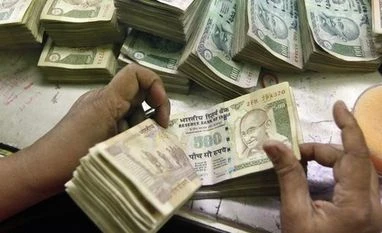
An employee counts Indian currency notes at a cash counter inside a bank in Kolkata. Photo: Reuters
Amid the debate about whether the rupee should be depreciated sharply to benefit exporters, currency market participants are not sure it will boost India’s prospects of cornering a larger slice of the global market.
However, the underlying message to the Reserve Bank of India (RBI) could be to lower rates. A low interest rate makes the country less attractive for foreign investors, which exerts further pressure on the rupee to depreciate.
Going by the real effective exchange rate (REER), which measures the rupee’s strength against a currency basket of India’s trading partners, the rupee is overvalued.
According to the Reserve Bank of India (RBI), the rupee’s REER value in a 36-currency export and trade basket was 115.43 at the end of the August. This means the rupee was overvalued by 15.43 per cent that month. In July the REER was 115.35, while in August 2015 the value was 114.81. In a six major currency basket, the rupee’s REER was 125.79, but to gauge export competitiveness, the 36-currency basket is the more apt. The rupee has always remained overvalued and the central bank is rarely seen allowing the REER value to cross 110. Whenever this level is crossed, the RBI has intervened to make the rupee stronger as that brings down import costs. And India always has been a net importer. However, now that import costs are low, thanks to cheap oil, there could be a case for bringing down the rupee’s value to aid exporters.
“It is doubtful if a weak rupee really helps in boosting exports,” said Jamal Mecklai, head of Mecklai Financial Services. “This seems to be more political than anything else. It could be a way of pushing the RBI for a rate cut,” he added. Satyajit Kanjilal, head of Forexserve, said, buyers of Indian goods rarely allowed exporters to enjoy the benefits of a depreciating currency. If the rupee depreciates by, say, 10 per cent, the buyer usually offers 90 cents for the good he earlier bought at $1.
“It is a zero-sum game. When we talk about sharp depreciation, we have to keep in mind a sharp reversal of fund flows too. The yen was 600 against the dollar in the 1990s and now it is 100, does that mean that Japan’s exports have fallen substantially? The quality of export matters,” said Kanjilal.
Indian exporters need the rupee to weaken to compete against Bangladesh and some other Southeast and East Asian nations that keep depreciating their currencies. But to do that, no outside mechanism is needed. In the face of increased inflows, which averaged about $1.5 billion a month in the last six months, the rupee will have to depreciate anyway.
“It will happen and there is no need for a mechanism to depreciate the currency. So far the RBI has been intervening to prevent the rupee from depreciating sharply, now it may not want to intervene as much. But, the depreciation will have to be a gradual and guided one,” said Samir Lodha, managing director of QuantArt, a currency and risk management firm.
Lodha sees the rupee hitting 70 to a dollar level in a few months if aggressive intervention is not pursued by the RBI. The rupee hit its record low of 68.85 a dollar on August 28, 2013. The rupee has fallen 1.3 per cent in the year to date, whereas most other Asian currencies have appreciated against the dollar. The South Korean won and Indonesian rupiyah have appreciated more than 4 per cent each against the dollar. On Thursday, the rupee closed at 67.02, down from its previous close of 66.895 as talk of a possible rupee depreciation started doing the rounds.

 "Rupee should weaken, but may not help exports: Experts")


 Connect with us on WhatsApp