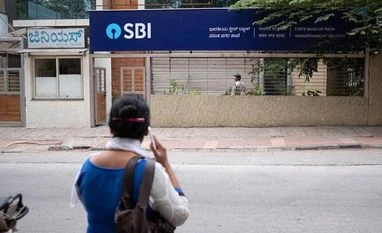
SBI logs its highest-ever quarterly profit at Rs 6,504 cr in Q1, up 55% YoY

Net interest income of the lender rose 3.74 per cent year-on-year to Rs 27,368 crore

SBI
Slippages during the quarter have come down sequentially to Rs 15,666 crore from Rs 21,934 crore
Subrata Panda Mumbai
5 min read Last Updated : Aug 04 2021 | 10:40 PM IST
State Bank of India (SBI) on Wednesday reported a 55-per cent year-on-year (YoY) rise in net profit to post its highest quarterly profit of Rs 6,504 crore during April-June (first quarter or Q1) of 2021-22 (FY22), compared to Rs 4,189.34 crore in the year-ago period.
 
The country’s largest lender beat Street estimates as a result of a rise in non-interest income and dip in provisions. 
 
Bloomberg analysts had estimated a net profit of Rs 5,855 crore in the reporting period.
 
Shares of the lender closed 2.37 per cent higher on the BSE at Rs 457.05 after the quarterly results announcement.
 
The state-owned bank's net interest income (NII) rose 3.74 per cent YoY to Rs 27,638 crore, from Rs 26,642 crore in Q1 of 2020-21 (FY21). The muted growth in NII is because the yield on advances has come down — there is a lot of money floating in the market, said the bank's management.
 
Its domestic net interest margin — a measure of profitability — contracted 9 basis points (bps) to 3.15 per cent. Non-interest income rose 24.28 per cent to Rs 11,803 crore, driven by fee income growth — up 20.86-per cent YoY. The bank has also recovered around Rs 1,692 crore from Kingfisher Airlines' account in this quarter.
 
Dinesh Kumar Khara, chairman, SBI, said, “As far as non-interest income is concerned, it continues to be a major focus. We have a large network of branches and a strong distribution network online. We have started leveraging these other channels of distribution, particularly YONO. It helps us to distribute the products of our subsidiaries through the digital medium.”
 
Loan-loss provisions stood at Rs 5,030 crore, down 46 per cent from the same period last year. However, it has increased its provision for standard assets substantially to Rs 1,578 crore, from Rs 282 crore a year ago. Other provisions increased to Rs 2,928 crore, from Rs 1,568 crore.
 
The total provisions held by the lender fell 19.6-per cent YoY to Rs 10,052 crore. The total non-non-performing asset (NPA) provisions held by the lender — not included in the provision coverage ratio — is Rs 29,816 crore, and includes continge­ncy provisions of Rs 9,065 crore.

As far as asset quality goes, the lender saw its gross NPAs go up 34-bps sequentially to 5.32 per cent and net NPAs move up 27 bps to 1.77 per cent.Slippages during the quarter have come down sequentially to Rs 15,666 crore, from Rs 21,934 crore in the previous quarter (Q4FY21). Of the Rs 15,666 crore of slippages, a significant amount has been pulled back in July.
 
In July, the bank recovered Rs 4,700 crore of the slippages reported for the June quarter. As restrictions were lifted, collections improved, said the bank's management.
 
“We have seen a very tough Q1. Our endeavour will be to keep the slippages under 2 per cent,” said Khara. Currently, the slippage ratio is at 2.47 per cent. 
 
“We have seen slippages from SMEs, as well as from home loans. Almost 50 per cent of the home loan book is to the non-salaried class. Many of the SME borrowers also would have availed of home loans. The stress is largely due to the disruption in cash flow of SMEs. Once cash-flow returns, our home loan borrowers will honour their obligations,” added Khara.   As of June 30, gross NPAs in the home loan segment were 1.39 per cent. With recoveries in July, they are now 1.14 per cent. "Hopefully, they will be less than 1 per cent," underscored the bank's management.
 
“When it comes to home loans, the market potential is huge. There is no reason for us to slow down,” said Khara.
 
Advances grew 5.64 per cent YoY to Rs 25.23 trillion at the end of the June quarter, mainly driven by retail, agriculture, and SME advances.
 
“Credit growth will be a function of the real economy. We are ready to support the credit requirement of the economy, both in terms of liquidity and capital,” said Khara.
 
As far as corporate credit is concerned, the bank is not merely looking to grow the top line. “If there are opportunities to grow the top line at the right price, we have enough liquidity and capital for it,” said Khara.
 
“We have seen under-utilisation to the extent of 26 per cent. Much of the drawdown will depend upon the promoters. If capacity utilisation and demand improve, the drawdown will be faster,” he added.
 
As of June 30, the bank has restructured loans to the tune of Rs 12,931 crore under the August 6 circular of the Reserve Bank of India (RBI).
 
Under restructuring 2.0 (May 5 RBI circular), the bank has approved 5,246 applications; 2,056 are still pending.
 
Its deposit book has grown 8.82 per cent YoY to Rs 37.2 trillion, with low-cost deposits growing 10.71-per cent YoY.
 

One subscription. Two world-class reads.

Already subscribed? Log in

Subscribe to read the full story →
*Subscribe to Business Standard digital and get complimentary access to The New York Times

Smart Quarterly

₹900

3 Months

₹300/Month

SAVE 25%

Smart Essential

₹2,700

1 Year

₹225/Month

SAVE 46%
*Complimentary New York Times access for the 2nd year will be given after 12 months

Super Saver

₹3,900

2 Years

₹162/Month

Subscribe

Renews automatically, cancel anytime

Here’s what’s included in our digital subscription plans

Exclusive premium stories online

  • Over 30 premium stories daily, handpicked by our editors

Complimentary Access to The New York Times

  • News, Games, Cooking, Audio, Wirecutter & The Athletic

Business Standard Epaper

  • Digital replica of our daily newspaper — with options to read, save, and share

Curated Newsletters

  • Insights on markets, finance, politics, tech, and more delivered to your inbox

Market Analysis & Investment Insights

  • In-depth market analysis & insights with access to The Smart Investor

Archives

  • Repository of articles and publications dating back to 1997

Ad-free Reading

  • Uninterrupted reading experience with no advertisements

Seamless Access Across All Devices

  • Access Business Standard across devices — mobile, tablet, or PC, via web or app

Topics :sbiQ1 results

Next Story