Having lost three key state elections in the Hindi heartland on account of farmers’ anger over falling prices, Finance Minister Piyush Goyal announced that the government would transfer Rs 6,000 a year into the bank accounts of all eligible small and marginal farmers to meet their investment needs.
Titled PM-KISAN (Pradhan Mantri Kisan Samman Nidhi), the support will be provided in three equal instalments of Rs 2,000 each in a year.
“There is a need for providing structured income support to the poor land-holder farmer families in the country for procuring inputs such as seeds, fertilisers, equipment, labour, etc, and to meet other needs. Such support will help them in avoiding indebtedness as well and falling into clutches of money lenders,” Goyal said while presenting the interim Budget of 2019-20.
The scheme is expected to benefit around 86.21 per cent of landholding farmers who own less than two hectares of land as in 2015-16 according to the provisional data of 10th agricultural census. In 2010-11, this number was around 84.97 per cent of total operational holdings, defined as all land used wholly or partly for agricultural production and is operated as one technical unit by one person alone or with others without regard to the title, legal form, size or location. The scheme will not cover tenant or landless farmers or labourers, which number almost 140 million.
Since the support works out to Rs 500 a month, farmers are unhappy. “This is a pittance. How can the government even imagine that farmers will benefit with a support of Rs 16.44 per day. It also remains to be seen how this scheme will be implemented on ground as that is the key,” said Ram Inaniya, a core member of Aam Kisan Union, a Madhya Pradesh-based farmers’ association.
“The major problem facing the farmers today is falling price of their produce…. I don’t know how an income support of Rs 6,000 per year will compensate for those losses. Also, how will the farmers be identified? Barring a few states, land records in most parts of the country are shabbily maintained,” Mahendra Dev, director of Indira Gandhi Institute of Development Research (IGIDR), pointed out.
Government estimates say around 120 million farmers will be benefitted from the scheme.
To enhance the programme’s appeal ahead of the 2019 general elections, the scheme has been started with retrospective effect from December 1, 2018, and the first instalment of Rs 2,000 per farmer is expected to be transferred in their bank accounts before March 31, 2019.
Goyal allocated Rs 20,000 crore for the scheme in the Revised Estimate (RE) of 2018-19 to be spent this year, and he has budgeted Rs 75,000 crore for the scheme for 2019-20.
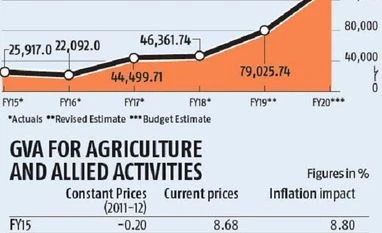
On account of the income support scheme, the total allocation for the farm sector rose to Rs 140,763.97 crore in 2019-20 (Budget Estimates), up almost 78 per cent from the RE of 2018-19.
According to the NABARD's All India Financial Inclusion Survey (NAFIS) released in August 2018, in 2015-16, the average annual income of an agricultural household was Rs 107,172 compared to Rs 87,228 for families engaged only in non-agricultural activities. This will now go up by Rs 6,000 approximately.
The same data also showed that a significant chunk of this income of a farmer household, that is almost 57 per cent, comes from non-farm sources, which the interim Budget fails to support.
The NABARD survey defines farm households as families having over Rs 5,000 as value of produce from agricultural operations in the year preceding the survey.
Apart from income support, the interim Budget also created a separate department for fisheries, which had been proposed by the United Progressive Alliance.
The interim Budget also announced the creation of a commission for welfare of cows, titled Rashtriya Kamdhenu Aayog.
That apart, it also announced restructuring of crop loans in the event of a natural calamity, and an extension on the interest subvention on timely loan repayment to the entire period of resettlement of such loans.
The interest subvention on short-term crop loans of 2 per cent, on which an additional 3 per cent was given on timely repayment, will now be extended to farmers pursuing animal husbandry who take loans through Kisan Credit Cards.

 "Interim Budget 2019: Income support scheme leaves farmers unhappy")












 Connect with us on WhatsApp