Home / World News / Activism hits even the less flashy tech companies
Activism hits even the less flashy tech companies
Among these firms are IBM, Hewlett Packard Enterprise, Qualcomm, Cisco, Dell and Oracle
premium
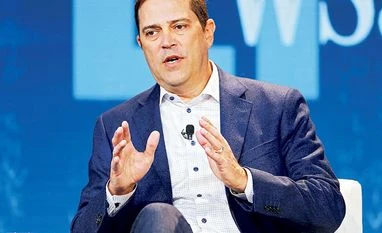
Chuck Robbins, the chief executive of Cisco, one of several tech giants that did not add their names to a court filing opposing President Trump’s immigration order. Photo: Reuters
As soon as President Trump signed his executive order on immigration, some of the biggest tech companies went quiet. Their executives did not sign legal briefs, brandish statements or dissent on Twitter. They strove for business as usual.
This was the older, stodgier, less glamourous part of the tech universe. These executives are generally not household names. Most of the companies have little presence in the excitable consumer marketplace. Some are government contractors. Their workers tend to be more settled, less tempted by cool start-ups. Despite the companies’ sizable employment, the spotlight is not on them.
Among these firms are IBM, Hewlett Packard Enterprise, Qualcomm, Cisco, Dell and Oracle. When 127 companies signed an amicus brief last week in a Seattle court that said the executive order “violates the immigration laws and the Constitution,” none of these six firms were on the list.
Yet even at some of these companies, there are stirrings of defiance. In a few well-publicised cases, workers have noisily quit. Many more have chosen to remain but are agitating for an explicit corporate morality even as Trump considers a new executive order on immigration. They want their companies to make clear not only what they support but also, perhaps even more important, what lines they will not cross.
The activist push is being driven in significant measure by women, who are still fighting for their due in a male-dominated industry. But in an unlikely twist, the chief executives they are trying to influence at two major companies are female.
At IBM, a petition has been circulating that proclaims, “We have a moral and business imperative to uphold the pillars of a free society by declining any projects which undermine liberty.” The organisers say nearly 1,000 verified employees have signed.
This is a delicate subject for big tech companies, none more than Big Blue. Trump during the campaign explored the idea of a Muslim database, although his remarks were inconclusive. IBM’s punch-card technology, as detailed by the United States Holocaust Memorial Museum, was used by the Nazis in 1939 to do a census. That data, in turn, led directly to Adolf Eichmann’s Jewish Registry.

 "Activism hits even the less flashy tech companies")












 Connect with us on WhatsApp