The "politics of demonisation" provided fertile ground for human rights abuses in 2017, exemplified by the response of Europe and Donald Trump's US to the refugee-crisis, rights group Amnesty said today in its annual report.
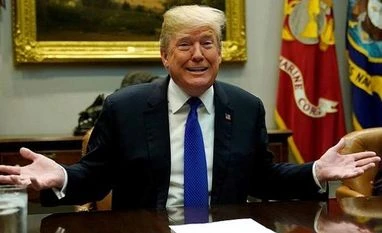
The British-based group took particular aim at the US president's "transparently hateful" executive order banning entry to citizens of several Muslim-majority countries.
"Throughout 2017, millions across the world experienced the bitter fruits of a rising politics of demonisation," said the report, which was launched this year for the first time in the United States.
It accused leaders of wealthy countries of approaching the refugee crisis "with a blend of evasion and outright callousness".
"Most European leaders have been unwilling to grapple with the big challenge of regulating migration safely and legally, and have decided that practically nothing is off limits in their efforts to keep refugees away from the continent's shores," it added.
Amnesty Secretary-General Salil Shetty singled out Trump for criticism, saying the travel ban "set the scene for a year in which leaders took the politics of hate to its most dangerous conclusion".
He also condemned his decision to keep the US camp at Guantanamo Bay on Cuba open, and his ambivalent attitude to waterboarding and other harsh interrogation techniques.
"You can imagine what this means for governments across the world who are extensively using torture," he said.
He noted that US attitudes had an impact across the world.
Tirana Hassan, director of crisis response at Amnesty International, said: "When it comes to conflict, crisis and mass atrocities we have seen zero moral or legal leadership coming from the international community."
Amnesty said Myanmar's military crackdown on Rohingya insurgents, which prompted an exodus of nearly 700,000 Rohingya people into neighbouring Bangladesh, was the "ultimate consequence of a society encouraged to hate, scapegoat and fear minorities".
"This episode will stand in history as yet another testament to the world's catastrophic failure to address conditions that provide fertile ground for mass atrocity crimes," said the report.
It highlighted recent elections in Austria, France, Germany and the Netherlands, where "some candidates sought to transpose social and economic anxieties into fear and blame", as evidence that the "global battle of values reached a new level of intensity" in 2017.
The report also accused governments of exploiting national security and terrorism concerns "to reconfigure the balance between state powers and individual freedoms".
"Europe has continued to slip towards a near-permanent state of securitisation," it warned.
"France, for example, ended its state of emergency in November, but only after adopting a new anti-terror law."
However, Amnesty said that it was possible for "ordinary people" to take back the initiative, noting the Florida students demanding more gun control after the Parkland school massacre.
"There is no better example of that than what we've seen with the kids in this country standing up against gun violence in the last few days," Shetty said.

 "Amnesty slams Donald Trump-led 'politics of demonisation")

