
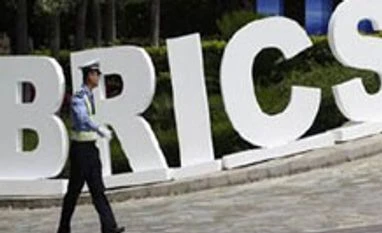
BRICS may decide on $100 billion fund early 2014: Russia
Fed's QE tapering expectations adds to urgency to make funds available to member nations
 "BRICS may decide on $100 billion fund early 2014: Russia")
WebinarsNew
Deep DiveNew
Explore Business Standard
Fed's QE tapering expectations adds to urgency to make funds available to member nations
Officials from Brazil, China, India, Russia and South Africa surprised many by starting work last year on the pool and a joint development bank to reshape the global financial architecture long dominated by rich nations.
But progress has been slow and the bank with a capital of up to $50 billion is still far from running, amid disagreements over burden sharing and where it should be based.
Expectations that the Federal Reserve would 'taper' its US bond-buying scheme have reversed the cheap dollar flows that had fuelled a boom among the BRICS, adding urgency to make funds available to members facing balance of payments difficulties.
"At the next BRICS meeting early in 2014, I believe that this matter may be discussed there and a final decision may be made on that," Siluanov said at a press briefing following the Group of 20 meeting.
The pool, however, will only become operational after ratification by each country's parliament.
CHINA'S ROLE
China, holder of the world's largest foreign exchange reserves and who is to contribute the bulk of the currency pool, wants a greater managing role, said one BRICS official.
"They feel that since they're giving the most, they should have an advantage," the official said.
Siluanov, asked at a briefing after the group met on the sidelines of the G20 on Thursday about China's desires, said that "(at this meeting) this has not been discussed."
China also wants to be the location of the headquarters of the group's development bank, one BRICS official said. Siluanov said the bank's main site remains one of the key issues to be resolved.
Another issue still to be resolved is the size of the initial capital, with Siluanov saying the discussion is whether it should be $10 billion or $30 billion.
"We spoke in favour of contributions in phases, $10 billion within 10 years, so it is not burdensome to Russia's budget and the budget of other countries," Siluanov said.
But some say China wants the bank's capital to be larger.
"Brazil and India want the initial capital to be shared equally. We know that China wants more," said a Brazilian official. "However, we are still negotiating, there are no tensions arising yet."
Siluanov said that the groups has agreed to decide on this "through a consensus."
First Published: Oct 12 2013 | 4:18 AM IST


 Connect with us on WhatsApp