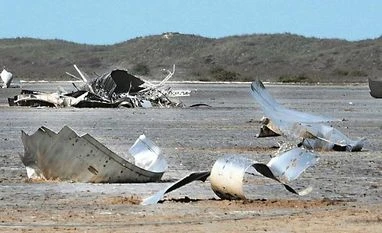
The crash of a 22-tonne, 33-metre Chinese rocket last weekend highlighted, once again, the problem of space junk. The Long March 5B Rocket splashed down safely into the sea near the Maldives. But this sort of incident will keep happening and each one poses some risks.
There are literally millions of bits and pieces of defunct satellites and rockets floating in orbit around the Earth. Space agencies and specialised outfits like the US Space Surveillance Network keep track of around 500,000 such objects with an aggregate weight of over 8,500 tonne.
“Floating”, in fact, is the wrong word. These objects circle the Earth in bands ranging from 160 km up to 36,000 km. They move at speeds of up to 28,000 kmph. They vary in size from tiny, barely discernible flecks to multi-tonne objects.
A lot of maths modelling is required to track and predict their paths. Satellites have even been launched for the specific purpose of studying debris. The best guess: 34,000 pieces of debris of 10 cm or larger. A standard calibre 9 millimetre bullet (10 mm = 1 centimetre) shot at 650 km per hour kills a man. Imagine what a 10 cm piece of metal travelling at 28,000 km is capable of. Given huge kinetic energy, collisions or crashes could do lots of damage.
Any space vessel headed to the International Space Station (ISS), or the Moon perhaps, has to navigate this celestial traffic jam. Every satellite launch has to estimate collisions. ISS itself orbits at around 400 km and it requires multiple orbital shifts to avoid potential collisions.
On an average day, one of the tracked objects drops out of orbit. Most burn up completely on re-entry to the atmosphere due to heat caused by friction. But a massive object like the Chinese rocket may not burn, and bits and pieces may be scattered across the world.
Out of orbit The Long March 5B rocket was used to put the Tianhe module of the new Chinese space station into orbit. But it was designed to fall back in uncontrolled fashion, and this is why China is being called irresponsible. Apart from being massive, the rocket had cryogenic fuel tanks containing an explosive mix of liquid oxygen and hydrogen under high pressure. These tanks will not burn due to friction because they’re designed to withstand heat and pressure.
The Chinese rocket is fourth on the list in terms of mass. Earlier, massive objects like the Nasa Skylab and the Soviet Salyut have dropped out of orbit. There was also the tragic loss of the Space Shuttle Challenger.
The space race started in 1957 when the erstwhile USSR put the first satellite, Sputnik, in orbit. In the following six decades, dead satellites, rocket boosters, debris created by target practice in missile and anti-missile tests have all ended up in orbit.
This is in addition to about 4,000 working satellites of sundry shapes and sizes. Due to the compulsions of celestial mechanics and designed-utility, these tend to be clustered together in bands. Bands like 900 to 1,000 km above Earth and 1,500 km are already past critical density.
Legality and expense It’s high time some junk was cleaned up. Every successive launch carries more risk and adds to the traffic jam. But there are legal issues involved apart from technological challenges. Defunct or not, satellites belong to somebody and that somebody has to sign off on getting rid of the object.
Removing space junk may require revisiting the Outer Space Treaty of 1967 and perhaps, setting up a joint UN task force. It may involve using weapons to shoot up debris. There have been demonstrations of such capabilities (including shoots by India and China). There’s also consensus under the treaty that space should not be militarised. Moreover, nations with this capability might not be too keen to demonstrate it, or share technology.
In 2009, the Russian Kosmos and an Iridium commercial satellite collided at a combined speed of over 42,000 kmph. Those were the last satellites to be destroyed in a collision but about 13,000 near-collisions are tracked every year and there have been many small collisions since.
There are many possible options for clearing junk. Financial models to incentivise clean-ups have also been suggested. A paper lead-authored by Akhil Rao of Middlebury College, Vermont suggests phased and escalated “orbital use fees” to incentivise clean-ups and offset increasing collision risks.
Clean-ups will be expensive. But at some stage, they will also be imperative. There’s a tipping point when the cost of clearing space junk will become worth it.
Cleaning up space

 "Why Chinese rocket's crash should alert us to the problem of space junk")












 Connect with us on WhatsApp