Syria must disclose the complete details of its chemical weapons and related facilities by next Saturday, a critical test of whether President Bashar al-Assad will comply with the US-Russian accord on finding, securing and eliminating his toxic armaments.
The plan agreed upon on Saturday by Russia and the US is to follow a "tightly fixed schedule" that envisions international monitors taking control of Syria's chemical weapons until they can be destroyed or removed from the country by mid-2014, a timetable that will be difficult to meet even if Assad's regime cooperates.
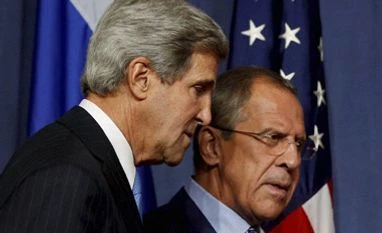
There are gaps in what officially is called a "framework" that add to the uncertainties about whether it will deliver as promised by US Secretary of State John Kerry and Russian Foreign Minister Sergei Lavrov. If Assad fails to comply, US President Barack Obama will again confront the issue of whether to use US military force.
"It's a wait-and-see game at this point,' said Faiza Patel, a former official at the Organisation for the Prohibition of Chemical Weapons (OPCW), the international body that oversees the Chemical Weapons Convention banning such arms.
''We'll see each step of the way how cooperative the Syrians are, and how much political will there is in the international community to actually support this effort," Patel, co-director of the Liberty and National Security Program at the Brennan Center for Justice at the New York University School of Law, said in a phone interview.
Syrian 'untrustworthiness' An initial question is whether Russia can deliver Assad, an ally fighting to survive, whom the US says was responsible for an August 21 attack using the nerve agent sarin that killed more than 1,400 people.
"The Assad regime is the essence of untrustworthiness," said Fred Hof, who last year served as Obama's ambassador-at-large on the Syria crisis. "Whether or not this agreement is an actual breakthrough depends primarily on the actions of those who own this toxic devil's brew and who have used it to kill innocent civilians."
The deal was worked out between Kerry and Lavrov without some basic facts, including the size of Assad's arsenal, where it's located, and how and where it might be destroyed. Assad had no immediate comment on the agreement, which goes to the United Nations Security Council - where Russia has a veto - to compel Syria's compliance.
"There can be no games, no room for avoidance or anything less than full compliance," Kerry told reporters yesterday in Geneva at a joint briefing with Lavrov. Kerry said Obama retains his military options.
Numbers game The US and Russia haven't agreed on the number of Syrian weapons sites, according to a State Department official who asked not to be identified because of the sensitivity of the negotiations. That will make it difficult to assess whether Assad has disclosed all of Syria's chemical weapons infrastructure, including the quantities and locations of the munitions, chemical agents and production equipment to be designated for destruction or removal.
Then it will be up to international monitors to try to verify the information. The accord says they should have "immediate and unfettered right to inspect any and all sites," language that could give them access to some of Assad's most sensitive military locations. The initial inspections of sites declared by Syria are to be completed by November, according to Saturday's agreement.
Exploiting technicalities "Given Assad's record, there's every reason to think Assad will stall, that he'll exploit technicalities, and that it would be likely that he would hide some chemical weapons, too," Robert Lieber, a professor of government and international affairs at Georgetown University in Washington, said in a phone interview.
Once sites are identified, international monitors from the OPCW and UN "should be dispatched as rapidly as possible to support control, removal, and destruction of Syria's chemical weapons capabilities," according to the plan. The US, UK, Russia, China and France - the five permanent members of the UN Security Council - may provide experts to assist in the effort, according to the agreement.

 "Chemical weapons pact faces major obstacles")


 Connect with us on WhatsApp