China unveiled a record fiscal deficit and pledged to accelerate the restructuring of its bloated state-owned industries while still setting a weaker growth target for this year.
Premier Li Keqiang announced a 6.5 per cent to 7 per cent expansion goal Saturday, down from an objective of about 7 per cent last year and the first range the government has offered since 1995. The government also abandoned its trade target, underscoring the degree of uncertainty about prospects for global growth. The details were given in Li's work report at the annual meeting of the ceremonial legislature in Beijing.
The plan reflected the government's determination to maintain growth and put off confronting its debt - now nearly 250 per cent of gross domestic product. The report also cited downward pressure on the economy against a backdrop of weaker global growth.
"The package of monetary stimulus, higher deficit, and restructuring of the state sector is a surprisingly coherent response to China's downturn," said Andrew Collier, an independent China analyst in Hong Kong and former president of the Bank of China International USA. "The problem is there's a lot of bad lending going on behind the scenes at the banks that's slipping through the cracks."
Underscoring the government's determination, Li said in his work report that China will need average annual growth of at least 6.5 per cent in the next five years to reach its target of doubling per capita income from 2010 levels.
Growth of 6.5 per cent would mark a ripping pace for most countries but would be the slowest in China in a quarter century as world's No 2 economy grapples with gyrating financial markets, softening global trade and efforts to reduce environmental degradation.
"Our country's development faces more and greater difficulties... so we must be prepared for a tough battle," Li said.
"On the one hand, we will focus on current realities and take targeted steps to withstand downward pressure on the economy," Li said in his report. "On the other hand, we must have our long-term development goals in mind, keep some policy tools as options for later use, strategise our moves and gather strength."
The slowest growth in 25 years has prompted officials to tweak monetary policy to "prudent with a slight easing bias" last month. On Monday, the central bank cut the ratio of reserves banks must lock away. Moody's Investors Service lowered China's credit-rating outlook to negative from stable Wednesday, highlighting a surging debt burden and falling currency reserves while questioning the government's ability to enact reforms.
While the leadership pledged to speed up the disposal of unproductive state assets, there was little on specifics. Li said the government would address zombie enterprises - inefficient and unproductive state-owned companies - via mergers and restructuring, while offering 100 billion yuan ($15 billion) for employees laid off as part of that process.
In lead up to parliament, the government flagged major job losses in key coal and steel industries. Overall, China aims to lay off 5-6 million state workers over the next two to three years, two sources said, in Beijing's boldest retrenchment programme in almost two decades.
Li said the country will create 10 million new jobs, address zombie firms through mergers, bankruptcies and debt deals, and hold the urban registered unemployment rate below 4.5 per cent in 2016.
Seeking to improve the environment, Beijing aims to cap total energy consumption at 5 billion tonnes of standard coal by 2020 and set targets for improving water efficiency.
China will increase military spending by 7.6 per cent this year, its lowest increase in six years, as it pursues a modernisation plan that will shrink staffing.
Unlike previous years, the documents did not mention a specific target for trade figures, having missed their goals repeatedly in recent years.
In the financial field, Communist leaders underscored commitments to free up interest rates and the yuan's exchange rate. In a possible nod to criticism about lack of policy clarity, China plans to develop forward-guidance communication at the central bank.
People's Bank of China Governor Zhou Xiaochuan will extend his recent streak of public comments in a press conference scheduled for March 12. Zhou broke months of silence in a February Caixin magazine interview, saying there's no basis for a continued yuan depreciation. Li's work plan said policy makers will improve the market-based mechanism for setting the exchange rate and keep the currency "generally stable."
The Finance Ministry's budget said the fiscal deficit would increase to 3 per cent of GDP from 2.3 per cent. Money supply will rise by 13 per cent, up from a 12 per cent 2015 goal. The deficit was the highest since the founding of the People's Republic of China in 1949, the Xinhua News Agency said Saturday. Policy makers also plan to push for injecting new life into the property market by seeking more mortgage lending, among other steps.
The premier's work report was released at the same time as the 2016 budget, the 2016-2020 Five-Year Plan and a report from the National Development and Reform Commission, the country's economy planner. China will push ahead with interest-rate liberalisation and deepen state-owned bank reform, the government said. The stock and bond markets will also be reformed.
The goal of a 6.5 per cent to 7 per cent expansion for this year compares to a median estimate for a 6.5 per cent growth in 2016, according to economists surveyed by Bloomberg News.
"The announced range for the indicative GDP growth rate is welcome," said Bert Hofman, the World Bank's country director in Beijing for China, Mongolia and Korea. "It provides needed flexibility for balancing structural reforms and demand management."

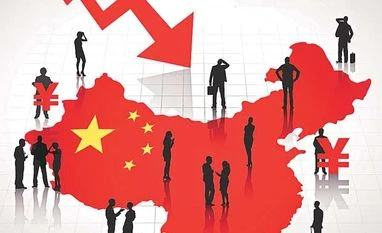 "China eases fiscal stance to meet slower 2016 growth target")


 Connect with us on WhatsApp