
Xi Jinping starts new term as China's President, Wang Qishan elected V-P
All top posts including the entire cabinet besides Governor of the Central Bank will be new set of officials
 "Xi Jinping starts new term as China's President, Wang Qishan elected V-P")
WebinarsNew
Deep DiveNew
Explore Business Standard
All top posts including the entire cabinet besides Governor of the Central Bank will be new set of officials
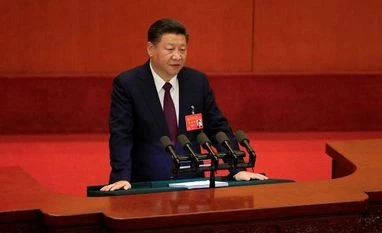
Chinese President Xi Jinping has been "re-elected" for a second five-year tenure on Saturday by China's rubber stamp parliament, the National People's Congress, days after scrapping two-term rule for the President paving the way for his lifelong tenure.
He has also been elected as the head of the powerful Central Military Commission, the overall high command of the Chinese military.
On March 11, over 2,900 deputies of the NPC have voted for the constitutional amendment for removing the two-term limit for President and Vice President proposed by the ruling Communist Party of China (CPC).
Originally Xi is set to retire by 2023 as head of the CPC, the military and Presidency following a two-term limit followed by his predecessors. He became President in 2013.
The two-term limit was adopted by the party after Mao's death to ensure collective leadership to avert mistakes like the dreaded cultural revolution in which millions were killed.
Significantly, Xi's loyalist and close confidant Wang Qishan, 69, has been elected as vice president, who like Xi is set for a lifelong tenure.
Wang, however got 2,969, one vote less in the carefully choreographed poll. Observers say the one vote dissent was officially sanctioned to show diversity in China's political system.
After the results were announced in the nationally televised show of the NPC proceedings, Xi bowed and shook hands with colleagues.
For the first time, he along with other officials took oath on the newly-amended Constitution swearing to be faithful to the charter of the People's Republic of China, defend its authority, be loyal to the country and the people.
The oath also stipulates that they will be committed and honest while performing duties, accept people's supervision and work hard to help build a great modern socialist country that is prosperous, strong, democratic, culturally advanced, harmonious and beautiful.
Another of Xi's close aides Li Zhanshu who was chief of staff was elected chairman of NPC. The parliament also ratified a new plan to revamp the government.
Wang is the most feared official in China as he carried out the anti-corruption campaign for the past five years initiated by Xi in which over 1.5 million officials including over 100 ministers and top generals were punished making it the biggest such crackdown in China's recent history.
Except Premier Li Keqiang, all top posts including the entire cabinet besides Governor of the Central Bank will be new set of officials.
From India's perspective for the new line-up of officials, China's Foreign Minister Wang Yi was widely expected to be elevated to be State Councillor which makes him the top diplomat of the country.
The elevation will entail him to become China's Special Representative for India-China boundary talks. The post is currently held by Yang Jiechi who has been elevated to the politburo, the top policy body of the ruling Communist Party of China, (CPC).
The line-up of the new government will be announced on Saturday, the South China Morning Post reported.
First Published: Mar 17 2018 | 10:54 AM IST


 Connect with us on WhatsApp