G7 to counter China's BRI with big infrastructure project: US official

West must offer an alternative to China, says official, adding that G7 will scold China over Xinjiang forced labour
g7
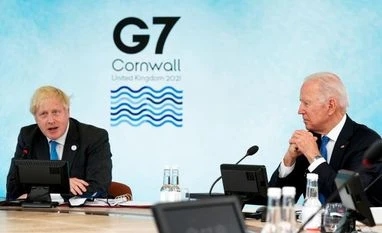
British Prime Minister Boris Johnson, left, speaks as President Joe Biden listens during the G7 summit at the Carbis Bay Hotel in Carbis Bay, St. Ives, Cornwall, England (Photo: AP/PTI)
Reuters
4 min read Last Updated : Jun 10 2022 | 12:23 PM IST
The Group of Seven will seek to rival China's multi-trillion-dollar Belt and Road initiative on Saturday by announcing a global infrastructure plan to help developing nations, a senior official in U.S. President Joe Biden's administration said.
 
The G7 is trying to find a coherent response to the growing assertiveness of President Xi Jinping after China's spectacular economic and military rise over the past 40 years.
 
The U.S. official, who spoke to reporters on condition of anonymity, said the United States would also push the other G7 leaders for "concrete action on forced labour" in China, and to include criticism of Beijing in their final communique from a three-day summit in southwest England.
 
"This is not just about confronting or taking on China," the official said. "But until now we haven't offered a positive alternative that reflects our values, our standards and our way of doing business."
 
China's Belt and Road Initiative (BRI) is a multi-trillion-dollar infrastructure scheme that Xi launched in 2013, involving development and investment initiatives that would stretch from Asia to Europe and beyond.
 
More than 100 countries have signed agreements with China to cooperate in BRI projects like railways, ports, highways and other infrastructure.
 
Critics say Xi's plan to create a modern version of the ancient Silk Road trade route to link China with Asia, Europe and beyond is a vehicle for the expansion of Communist China.
 
Beijing says such doubts betray the "imperial hangover" of many Western powers that humiliated China for centuries.
 
CHINA'S RISE
 
The re-emergence of China as a leading global power is considered to be one of the most significant geopolitical events of recent times, alongside the 1991 fall of the Soviet Union that ended the Cold War.
 
China in 1979 had an economy that was smaller than Italy's, but after opening to foreign investment and introducing market reforms, it has become the world’s second-largest economy and is a global leader in a range of new technologies.
 
Leaders of the G7 - the United States, Canada, Britain, Germany, Italy, France and Japan - want to use their gathering in the seaside resort of Carbis Bay to show the world that the richest democracies can offer an alternative to China's growing clout.
 
The U.S. official said until now, the West had failed to offer a positive alternative to the "lack of transparency, poor environmental and labour standards, and coercive approach" of the Chinese government that had left many countries worse off.
 
"So tomorrow we’ll be announcing ‘build back better for the world,’ an ambitious new global infrastructure initiative with our G7 partners that won’t just be an alternative to the BRI," the official said.
According to a Refinitiv database, as of mid-last year, more than 2,600 projects at a cost of $3.7 trillion were linked to the Belt and Road Initiative, although the Chinese foreign ministry said last June that about 20% of projects had been seriously affected by the COVID-19 pandemic.
 
In March, Biden said he had suggested to British Prime Minister Boris Johnson, hosting the G7 summit, that democratic countries should develop their own rival scheme.
 
FORCED LABOUR
 
In talks, Biden will also press the other leaders to make clear that they believe forced labour practices are an affront to human dignity and "an egregious example of China's unfair economic competition".
 
"We're pushing on being specific on areas like Xinjiang where forced labour is taking place and where we have to express our values as a G7," the official said of the final communique to be issued at the end of the summit on Sunday.
 
China denies all accusations of abuse in the Xinjiang region.
 
There were no specifics on how the global infrastructure scheme would be funded. The plan would involve raising hundreds of billions in public and private money to help close a $40 trillion infrastructure gap in needy countries by 2035, the official said.
 
The aim was to work with the U.S. Congress to supplement existing development financing "with the hope that, together with G7 partners, the private sector and other stakeholders, we soon be collectively catalyzing hundreds of billions of dollars in infrastructure investment for low and middle income countries that need it".

One subscription. Two world-class reads.

Already subscribed? Log in

Subscribe to read the full story →
*Subscribe to Business Standard digital and get complimentary access to The New York Times

Smart Quarterly

₹900

3 Months

₹300/Month

SAVE 25%

Smart Essential

₹2,700

1 Year

₹225/Month

SAVE 46%
*Complimentary New York Times access for the 2nd year will be given after 12 months

Super Saver

₹3,900

2 Years

₹162/Month

Subscribe

Renews automatically, cancel anytime

Here’s what’s included in our digital subscription plans

Exclusive premium stories online

  • Over 30 premium stories daily, handpicked by our editors

Complimentary Access to The New York Times

  • News, Games, Cooking, Audio, Wirecutter & The Athletic

Business Standard Epaper

  • Digital replica of our daily newspaper — with options to read, save, and share

Curated Newsletters

  • Insights on markets, finance, politics, tech, and more delivered to your inbox

Market Analysis & Investment Insights

  • In-depth market analysis & insights with access to The Smart Investor

Archives

  • Repository of articles and publications dating back to 1997

Ad-free Reading

  • Uninterrupted reading experience with no advertisements

Seamless Access Across All Devices

  • Access Business Standard across devices — mobile, tablet, or PC, via web or app

Topics :ChinaG7 summit

Next Story



