
Gas price cap: European Union lawmakers struggle to iron out differences
For now, the commission says, Europe's gas storage capacity stands at about 90 per cent, even as Russian gas supplies to the EU declined
 "Gas price cap: European Union lawmakers struggle to iron out differences")
WebinarsNew
Deep DiveNew
Explore Business Standard
For now, the commission says, Europe's gas storage capacity stands at about 90 per cent, even as Russian gas supplies to the EU declined
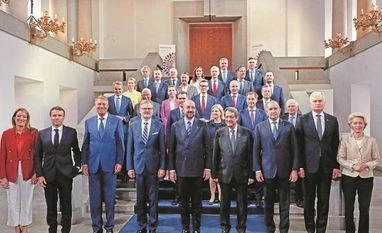
European Union leaders converged on Prague Castle on a crisp Friday morning to try to bridge significant differences over a natural gas price cap as winter approaches and Russia's war on Ukraine fuels a major energy crisis.
The price cap is one of several measures the 27-nation bloc is preparing to contain an energy crisis in Europe that is driving up prices for consumers and business and which could lead to rolling blackouts, shuttered factories and a deep recession over the winter.
As the Europeans bolster their support for Ukraine in the form of weapons, money and aid, Russia has reduced or cut off natural gas to 13 member nations, leading to surging gas and electricity prices that could climb higher as demand peaks during the cold months.
Standing in the way of an agreement is the simple fact that each member country depends on different energy sources and suppliers, and they're struggling to see eye-to-eye on the best way ahead.
A group of 15 member countries has urged the EU's executive branch, the European Commission, to propose a cap on gas prices as soon as possible, but the idea has not secured unanimous support, with Germany notably blocking.
For now, the commission says, Europe's gas storage capacity stands at about 90 per cent, even as Russian gas supplies to the EU declined by 37 per cent between January and August, with the US and Norway stepping in to provide liquefied natural gas. But those replacement supplies have not been cheap.
I therefore recommend stepping up negotiations with our reliable suppliers to reduce the prices of imported gas of all kinds, commission President Ursula von der Leyen said in a letter to the leaders ahead of Friday's summit in the Czech capital.
Von der Leyen also recommended that countries work together to develop an intervention to limit prices in the natural gas market, where prices have fluctuated wildly over jitters about the war and potentially uncoordinated national responses to the problem.
For now, a breakthrough on the price cap seems a distant prospect, but the leaders may make enough progress to conclude some kind of agreement when they meet again in Brussels on October 20-21.
(Only the headline and picture of this report may have been reworked by the Business Standard staff; the rest of the content is auto-generated from a syndicated feed.)
First Published: Oct 07 2022 | 9:44 PM IST


 Connect with us on WhatsApp