
India to launch database on crimes against peacekeepers to fight impunity
Jaishankar said that the UN and the country where the peacekeepers serve have to ensure that they are safe and those attacking them are punished
 "India to launch database on crimes against peacekeepers to fight impunity")
WebinarsNew
Deep DiveNew
Explore Business Standard
Jaishankar said that the UN and the country where the peacekeepers serve have to ensure that they are safe and those attacking them are punished
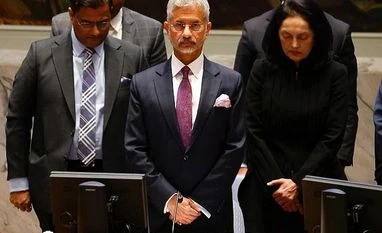
India's External Affairs Minister S. Jaishankar has announced that New Delhi will be setting up a comprehensive database to monitor crimes against peacekeepers and aid the fight against impunity.
Citing the "exponential increase" in crimes against peacekeepers, he said on Thursday that the "comprehensive databases and analytical tools for recording and assessing crimes against peacekeepers will be key to addressing impunity".
He said that the UN and the country where the peacekeepers serve have to ensure that they are safe and those attacking them are punished.
"Technology can be a force multiplier in achieving these goals" and "India has facilitated the launch of a database, which will record all crimes against UN peacekeepers", he said at the launch of a UN group of 35 countries to tackle the problem.
India, Bangladesh, Egypt, France, Morocco and Nepal launched the Group of Friends on Accountability for Crimes against UN Peacekeepers a day after an Irish peacekeeper was killed in Lebanon highlighting the gravity of the problem.
Under-Secretary-General for Peace Operations Jean-Pierre Lacroix said, "Unfortunately, very few of those responsible for such crimes have been brought to justice. This impunity remains largely the norm."
He said that "these crimes are often committed in areas where the authority of the state may be limited and national law enforcement personnel may be absent" making it a challenge to ensure accountability.
Jaishankar said, "In the last three years alone, 68 peacekeepers belonging to 20 countries have lost their lives for the cause of peace."
India is historically the largest contributor of personnel to UN Peacekeeping Operations and 177 of its citizens have been killed.
Peacekeepers from across the world "venture forth into hostile conflict zones to protect those who are unable to protect themselves" and "it is our solemn duty to protect the protectors", Jaishankar said.
He said, "When crimes are committed against peacekeepers, it is important that member states, peacekeeping mission commands and the Secretariat insist on a timely investigative process and help host states by providing them necessary expertise, resources, and political encouragement to make the rule of law institutions capable of promoting accountability and delivering justice."
(Arul Louis can be contacted at arul.l@ians.in and followed at @arulouis)
--IANS
arul/sha
(Only the headline and picture of this report may have been reworked by the Business Standard staff; the rest of the content is auto-generated from a syndicated feed.)
First Published: Dec 16 2022 | 9:00 AM IST


 Connect with us on WhatsApp