As negotiations over Britain’s exit from the European Union (EU) creak into motion, the bloc’s most powerful politician is being thrown into a familiar role: trying to bridge divergent interests in her country and across the continent.
After the UK voted to leave the EU, several European politicians, including French President François Hollande, and the heads of the main EU institutions called for swift retribution in the shape of a clean British exit. But German Chancellor Angela Merkel had a different message: Take a deep breath.
Europe must avoid “drawing fast and simple conclusions from the referendum in Great Britain that will only divide Europe further,” Merkel said Friday. Rather, she went on, European countries must “analyse and evaluate the situation calmly and prudently, and jointly make the right decisions on this foundation.”
The comments signaled that Merkel wasn’t about to rush into a painful divorce with Britain to discourage copycat EU exits, as many other leaders around the bloc, facing populist insurgencies of their own, are hoping for. Nor was she about to endorse a U-turn in immigration policy, as many critics to her right have been urging.
Rather, she was reflecting the balancing act she faces over the coming days and months: how to avoid creating incentives for other countries to leave the EU while limiting the damage to Germany’s export-reliant economy, with its handsome trade surplus with the UK.
“Our goal should be to shape the future relationship of Great Britain with the European Union as being tight and partner-like,” Merkel said. “The German government will pay special attention to the interests of German citizens and German business.”
Hours after the British result became clear, German business associations were already delivering dire warnings of what was to come. The Federation of German Industries, or BDI, predicted a “significant decline of business with Britain.”
“It is in the interest of both German and British companies that we get a new code of trade relationships as soon as possible,” BDI Chief Executive Markus Kerber said, “so that this exchange of goods, on which so many jobs in both countries depend, is disrupted as little as possible.”
German officials said it was crucial not to rush into decisions on how to deal with the UK, and that the British government should not be strong-armed into triggering the immediate start of departure negotiations, but given time to decide how Britain’s new relationship with the EU should look. German officials suggested Berlin would look favourably on forging a new bond with the UK that preserved trade—though perhaps not one that would completely shield the country from EU migrants, as the Leave camp in Britain is hoping.
“Europe will now stand together,” Merkel’s powerful finance minister, Wolfgang Schäuble, said. “Together we must make the best out of this decision of our British friends.”
But even as she tries to limit the impact of the UK vote on Germany’s economy, the center-right Ms Merkel will have to contend not just with the fear and impatience of her EU peers, but also with rising political pressure from both sides of the political spectrum.
To her left, Ms Merkel faces a restless governing partner, the Social Democratic Party, which is increasingly looking to score partisan points as its ratings melt ahead of next year’s national elections. Commenting on the aftermath of the “Brexit” vote Friday, Vice Chancellor Sigmar Gabriel, the Social Democrats’ chairman, took a thinly veiled swipe at Merkel’s push for austerity in bailed-out eurozone countries such as Greece.
“The young people of Europe aren’t going to get work through austerity alone,” Gabriel said. “I expect that as a consequence of today, the German government will debate anew how we can use our investment in the future of Europe, together with others in Europe, to improve the situation of the people.”
To her right, the Brexit vote gives a boost to Merkel critics who say that her decision last year to keep German borders open as hundreds of thousands of refugees and migrants streamed into the country has contributed to the EU’s troubles.
“The strong migratory pressure that Europe did little to counter was very threatening, also for the British, and certainly contributed” to the referendum result, conservative lawmaker Hans-Peter Friedrich, a former member of Merkel’s cabinet, said. “One can’t govern over the others’ heads—one has to bring them along.”
In a closed-door meeting with allied members of parliament on Friday, another lawmaker also confronted Merkel with the claim that her welcoming migration policy may have pushed British voters to reject the EU, according to a person who was there.
Merkel rejected the criticism, the person said, with the chancellor arguing that Britain’s debate about immigration revolved mainly around the EU’s free movement of labour bringing Europeans to the UK in search for work.
Ms. Merkel’s challenge now is in some ways a reprise of the Ukraine crisis, in which she played the key role in uniting all 28 EU countries behind a joint policy of sanctions against Russia. But German officials took pains on Friday to underscore that there was no precedent to the looming talks with Britain. “None of us have any experience with this process,” Merkel’s spokesman, Steffen Seibert, said, “and we had hoped not to experience it.”

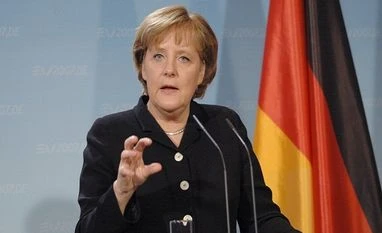 "Merkel plays for time as Brexit moves into gear")












 Connect with us on WhatsApp