US visa tremors rock Indian information technology

Numbers suggest that tech MNCs are applying for more H1B visas than Indian IT companies
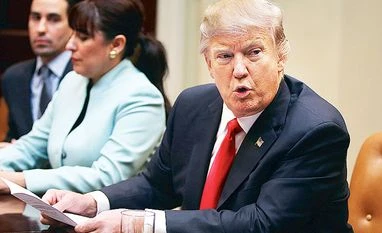
US President Donald Trump holds breakfast meeting with small business leaders at the Roosevelt room of the White House in Washington, on Tuesday
US President Donald Trump holds breakfast meeting with small business leaders at the Roosevelt room of the White House in Washington, on Tuesday. (Reuters)
Ayan PramanikShivani Shinde Nadhe Bengaluru/ Pune
Last Updated : Feb 01 2017 | 2:31 AM IST
India’s information technology industry will face short-term challenges if the Bill to double minimum wages for H1B visa-holders is passed in the US Congress. The impact will be felt by American technology companies such as IBM, Accenture and Microsoft, which have been sending Indian engineers on these visas to the US.

A California lawmaker Zoe Lofgren on Tuesday introduced a Bill in the US Congress requiring companies that employ workers on H1B visas to double their minimum pay to $130,000 a year, the first revision  proposed in nearly two decades. The legislative process will take time.

US President Donald Trump was likely to issue an executive order restricting H1B visas, his spokesperson Sean Spicer said separately.

The development forced investors to sell IT stocks, dragging shares of TCS, Tech Mahindra and HCL Technologies down. The BSE IT index was down 2.96% to 9,586.34 on Tuesday.

“If this proposal is accepted it will mean short-term pain for Indian IT services players but in the long run they will figure out ways of circumventing it. This will also impact global technology players, so do expect some pushback from these companies against this Bill,” said DD Mishra, research director at Gartner.

A November study by brokerage JP Morgan said Indian IT services firms had been reducing their dependence on H1B visas and were hiring local workers in the US. In contrast, IBM, Accenture and Microsoft have applied and been granted a higher number of these short-term work visas to send engineers to work in the US.

“Indian nationals account for 69% of the total H1B visas issued; this percentage has been rising over the years helped by applications from Indian nationals from outside India and increasingly from MNCs using India as an important resource base,” wrote analysts Viju K George and Anshul Agrawal in the report.

The top ten IT firms account for 23% of the total new H1B visas approved (109,292) in 2015, and excluding IBM and Accenture this falls to 18%, according to the report.

“The approved visa petition count for Indian IT firms has dropped to 39% in 2014-15. Within this, TCS, Wipro, Infosys, Tech Mahindra, Cognizant and HCL Technologies collectively received 44% fewer visa petition approvals,” the report said.

Indian firms have collectively hired over 50,000  local engineers in the US over the last decade and have stepped up efforts to hire more from campuses and other US firms.

“Some of them had already started hiring more on-site. What they did not expect is that there would be a proposal to double the minimum wage for H1B visa-holders. While both Indian and US companies will focus on more offshoring, for certain types of service delivery, firms will mandatorily need on-site presence,” said an analyst with a global brokerage firm.

Indian software lobby group Nasscom, which will take US technology firms in a delegation in February to meet the Trump administration, has argued that America faces a shortage of over 1 million computer science engineers and the Bill has loopholes that will nullify the objective of saving American jobs.
.
“Our suggestion is that they should calibrate the conditions keeping in mind the skills shortage in the US. Once that is done, they should not leave any loopholes in the rules being framed that leave some channels open for circumventing the limits,” said Nasscom President R Chandrasekhar in a statement.

“Raising wage levels for dependent companies alone will defeat the basic objective as non-dependent companies can continue to bring in skilled workers at lower wage levels,” he added.

Source: JP Morgan report on H1B  Visa, Computer world, National Foundation for American Policy

One subscription. Two world-class reads.

Already subscribed? Log in

Subscribe to read the full story →
*Subscribe to Business Standard digital and get complimentary access to The New York Times

Smart Quarterly

₹900

3 Months

₹300/Month

SAVE 25%

Smart Essential

₹2,700

1 Year

₹225/Month

SAVE 46%
*Complimentary New York Times access for the 2nd year will be given after 12 months

Super Saver

₹3,900

2 Years

₹162/Month

Subscribe

Renews automatically, cancel anytime

Here’s what’s included in our digital subscription plans

Exclusive premium stories online

  • Over 30 premium stories daily, handpicked by our editors

Complimentary Access to The New York Times

  • News, Games, Cooking, Audio, Wirecutter & The Athletic

Business Standard Epaper

  • Digital replica of our daily newspaper — with options to read, save, and share

Curated Newsletters

  • Insights on markets, finance, politics, tech, and more delivered to your inbox

Market Analysis & Investment Insights

  • In-depth market analysis & insights with access to The Smart Investor

Archives

  • Repository of articles and publications dating back to 1997

Ad-free Reading

  • Uninterrupted reading experience with no advertisements

Seamless Access Across All Devices

  • Access Business Standard across devices — mobile, tablet, or PC, via web or app

Next Story



