
Pak military likely had role in abrupt ending of Imran's march: Report
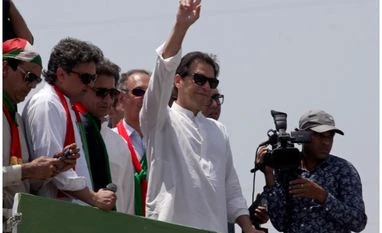
PTI chairman Imran Khan's surprise decision about not going ahead with the sit-in at the end of the long march left almost everyone baffled, foes and allies alike
 "Pak military likely had role in abrupt ending of Imran's march: Report")
Explore Business Standard
PTI chairman Imran Khan's surprise decision about not going ahead with the sit-in at the end of the long march left almost everyone baffled, foes and allies alike
Pakistan Tehreek-i-Insaf (PTI) chairman Imran Khans surprise decision about not going ahead with the sit-in at the end of the long march left almost everyone baffled, foes and allies alike, but there is convergence on one thing, the manner in which it all ended, at least for now, carried clear indications of who made it happen, a media report said.
The general perception, though most shy away from saying that openly, is that the military had to ultimately play its role to prevent things from getting out of control, the Dawn news report said.
Former Pakistan National Security Adviser retired Lt Gen Naeem Khalid Lodhi candidly admits that he too agrees with this.
"There is a strong possibility of positive interference by the military to prevent chaos and seek a return of semblance of political stability so that the process for resuscitating the economy could begin."
Another retired general, on the condition of anonymity, said there was a realisation in the top brass that no one at the helm of affairs would be able to escape responsibility if matters were to go in a wrong direction, Dawn reported.
The biggest challenge for the military, a source claimed, was to open up communication channels with Khan, especially in view of their frayed relations. But, as the former Prime Minister proceeded with the long march plans, a sense of urgency was felt everywhere and multiple channels were employed to bring him around, Dawn news reported.
The source said those who acted as a go-between included a former chief justice, a leading businessman, and a retired general.
"It was not an easy task given Imran Khan's obstinacy and the fact that he had invested a lot of effort into it," the source privy to the negotiations said.
Though the source did not share the chronology of the negotiations, it appeared from the discussion that they continued late into Wednesday night and probably into the early hours of Thursday.
--IANS
san/ksk/
(Only the headline and picture of this report may have been reworked by the Business Standard staff; the rest of the content is auto-generated from a syndicated feed.)
First Published: May 28 2022 | 1:20 PM IST

