
Power outage alert in Japan amid earthquake damage, cold weather
The magnitude-7.4 earthquake off the coast of Fukushima on March 16 killed four people and injured more than 230 others
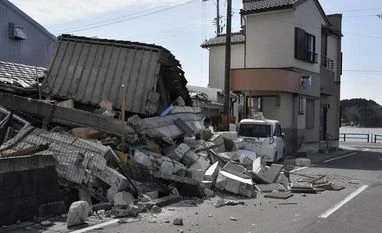 "Power outage alert in Japan amid earthquake damage, cold weather")
WebinarsNew
Deep DiveNew
Explore Business Standard
The magnitude-7.4 earthquake off the coast of Fukushima on March 16 killed four people and injured more than 230 others
Japanese were on Tuesday urged to conserve energy as the government warned of potential blackouts here due to a shortfall in power generation after several coal-fired plants temporarily stopped generating electricity following an earthquake last week.
The rare alert on Tuesday came as people used more heat than usual due to snow and unusually cold weather for the early spring.
The magnitude-7.4 earthquake off the coast of Fukushima on March 16 killed four people and injured more than 230 others.
It was a reminder of the deadly March 2011 quake and tsunami that killed thousands, triggered a nuclear disaster and devastated northeastern Japan's coast.
Last week's quake caused temporary power outages, peaking at two million homes in Tokyo and eight other areas, as the coal-fired plants in the region serviced by the Tokyo Electric Power Company Holdings assessed and repaired damage.
Several plants are still down and might not resume operations for several months.
With the power grid under unusual strain, Economy and Industry Minister Koichi Hagiuda warned the conservation effort might not avert blackouts.
He asked department stores, supermarkets and convenience stores to turn off their neon signs and urged factories to conserve as much power as possible.
Tokyo's Haneda International Airport turned off some lighting and air conditioning in its terminals.
Tokyo's SkyTree tower cancelled its nighttime light up on Tuesday. Amusement parks and some companies in the region switched to backup generators.
Later Tuesday, the government and the utility's subsidiary, TEPCO Power Grid, said conservation efforts across the region had largely lifted the threat of blackouts, but the power crunch alert would to stay in place overnight.
The company earlier on Tuesday warned that as many as three million homes could lose electricity sometime after 8 p.m. local time.
Tuesday's power crunch was believed to be among the worst since the government conducted planned outages in the Tokyo area for 10 days after the Fukushima Daiichi meltdowns in 2011.
Tuesday marked the end of nationwide COVID-19 restrictions as outbreaks have abated. Bars and restaurants were to return to normal service hours, though guests might be dining in dim lighting.
As of the early evening no blackouts were reported and the utility's subsidiary, TEPCO Power Grid, said the power supply had stabilised somewhat after utilities in other regions provided up to 927,400 kilowatts.
(Only the headline and picture of this report may have been reworked by the Business Standard staff; the rest of the content is auto-generated from a syndicated feed.)
First Published: Mar 22 2022 | 7:11 PM IST


 Connect with us on WhatsApp