President Donald Trump is breaking with recent US convention by portraying China as a rival that wants to undermine American prosperity. But it may take more than an aggressive tone to change the complex relationship between two economies that are joined at the hip.
In a new national-security strategy released Monday, the White House lumped China with Russia as powers seeking to “challenge American power, influence, and interests,” and attempting to erode the country’s security and prosperity. “We will attempt to build a great partnership with those and other countries, but in a manner that always protects our national interest,” Trump said in a speech in Washington.
The new rhetoric contrasts with the more collaborative approach of former President Barack Obama, who courted China as an economic partner even as the US asserted its military power in Asia.
Under his America First approach to foreign policy, Trump says he will try to eliminate America’s $500-billion total trade deficit by insisting on “fair and reciprocal” commerce with other nations, and strengthen the national security test for foreign investments. At the same time, Trump is juggling the more imminent need of working with China to address North Korea’s nuclear weapons program.
The US strategy may convince China to ease some trade barriers, giving US firms more access to the world’s second-biggest economy. But it will be difficult to eliminate America’s $309-billion trade shortfall with China without deeper reforms to the nature of each country’s economy.
That’s because trade flows are heavily influenced by the amount that countries save and invest. When a nation invests more than it saves, as the US does, it will import more than it exports, and finance the resulting current-account deficit by borrowing from abroad.
“China has lots of protections in place, so the US has legitimate issues on market access,” said David Dollar, a senior fellow at the Brookings Institution who worked as the US Treasury’s economic emissary to China under Obama. “But even if they did everything we wanted, it wouldn’t necessarily change the trade balance.”
The US and other countries have been pushing China for years to transition from an export-driven, state-led growth model to one more reliant on domestic consumption. bloomberg

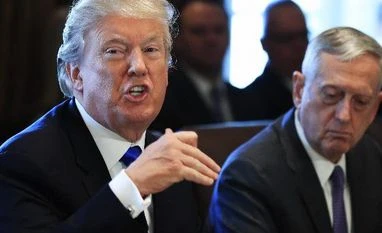 "President Donald Trump ignores deep ties with China")












 Connect with us on WhatsApp