Home / World News / Russia says rebels bombed exit corridor in Syria's Ghouta during truce
Russia says rebels bombed exit corridor in Syria's Ghouta during truce
Russian President Vladimir Putin had ordered a five-hour daily humanitarian pause to allow civilians to exit the region
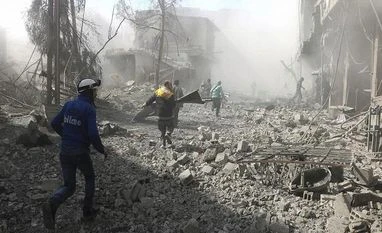
members of the Syrian Civil Defense run to help survivors from a street that attacked by airstrikes and shelling of the Syrian government forces, in Ghouta (Photo: AP | PTI)
The Russian military today accused Syria's rebels of shelling a humanitarian corridor that Moscow set up with the Syrian government, offering residents of Damascus' besieged eastern suburbs a way out of the embattled enclave.
Russian President Vladimir Putin had ordered a five-hour daily humanitarian pause to allow civilians to exit the region. The daily pauses began on Tuesday but so far, no humanitarian aid has gone in - and no civilians have left the area, known as eastern Ghouta.
The eastern suburbs - a cluster of several towns and villages on Damascus' eastern edge - have faced a deadly and brutal onslaught for weeks by Syrian government troops, backed by Russia.
Residents say they do not trust the truce and the UN and aid agencies have criticized the unilateral arrangement, saying it gave no guarantees of safety for residents wishing to leave.
The eastern Ghouta residents also fear their region would meet the same fate as the eastern, rebel-held half of the city of Aleppo, where a similar Russian-ordered pause in 2016 called on residents to evacuate the area and for gunmen to lay down their arms.
A full ground assault followed, finally bringing Aleppo under government control.
Russian Maj. Gen. Vladimir Zolotukhin told Russia news agencies that the militants who control the suburbs are shelling the route, manned by Syrian and Russian forces, and preventing evacuations.
State-run al-Ikhbariya TV reported that dozens of civilians had gathered on the edge of eastern Ghotua to leave, but were prevented by insurgents from reaching a crossing point into government-controlled areas.
The Britain-based Syrian Observatory for Human Rights said before the truce went into effect at 9 a.m. today, government shelling and airstrikes on eastern Ghouta killed three people. The opposition's Syrian Civil Defense, also known as White Helmets, confirmed the casualty figure.
State-run Syrian Arab News Agency, SANA, today said that a civilian was wounded by a mortar shell fired by the insurgents in eastern Ghouta at the Bab al-Salam area in the old city of Damascus.
The Russia-ordered pause came after a UN Security Council resolution calling for a nationwide 30-day cease-fire failed to take hold. While the relentless bombing has somewhat subsided in eastern Ghouta, home to around 400,000 civilians, the Syrian government's push to squeeze the insurgents out of the region continued.
Elsewhere in Syria, a convoy of 28 trucks carrying aid entered the northern Kurdish enclave of Afrin, where Turkish troops have been on the offensive since June 20 against Syrian Kurdish fighters.
The government-controlled Syrian Central Military Media said Turkish troops and Turkey-backed opposition fighters targeting the convoy near the village of Marimameen.
The Observatory said Turkish warplanes conducted airstrikes as the convoy was heading toward Afrin.
Ankara has said that Turkey would not suspend its military operations against the Syrian Kurdish fighters during the 30-day cease-fire demanded by the United Nations.

 "Russia says rebels bombed exit corridor in Syria's Ghouta during truce")


 Connect with us on WhatsApp