SoftBank Group founder Masayoshi Son and Alibaba's Jack Ma part ways

"It's not like we had a fight," Son said during the virtual shareholder meeting. "This was perfectly amicable."
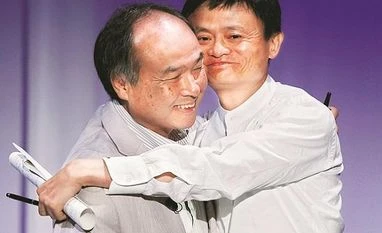
Masayoshi son, Jack ma, softbank, alibaba
“It’s not like we had a fight. This was perfectly amicable,” said Masayoshi Son (left). Son is known for anointing the entrepreneurs he finds particularly promising as “the next Jack Ma” (right).
Bloomberg
4 min read Last Updated : Jun 26 2020 | 2:21 AM IST
SoftBank Group founder Masayoshi Son ended his company’s annual shareholder meeting with a surprise on Thursday by announcing he’s stepping down from the board of Chinese e-commerce titan Alibaba Group Holding.

The billionaire said his departure shouldn’t be interpreted as signifying any disagreements, even though Alibaba co-founder Jack Ma is quitting SoftBank’s board at the same time. Ma and Son have maintained a close friendship since the Japanese entrepreneur was an early investor in Alibaba and helped it along to its current value of roughly $600 billion, calling it the crown jewel of SoftBank’s portfolio.

“It’s not like we had a fight,” Son said during the virtual shareholder meeting. “This was perfectly amicable.”

While the mutual departures are unlikely to have an immediate impact on either company, they mark the end of an era. The two men are among the most successful entrepreneurs of their generation and have been able to rely on each other’s advice for decades.  Son was on Alibaba’s board as it went public in 2014 in the largest initial public offering in history. When SoftBank ran into trouble with investment losses this year, Son was able to use his Alibaba stake to raise much-needed capital.  Alibaba remains Son’s most successful investment by far and SoftBank’s most valuable asset. In early 2000, Son invested $20 million into the then-unknown web portal connecting Chinese manufacturers with overseas buyers, a stake that is now worth more than $150 billion. That spectacular return cemented his reputation as an investor and later helped him raise the $100 billion Vision Fund. Son has previously spoken highly of Ma.

“He had no business plan, zero revenue,” Son said about Ma on The David Rubenstein Show. “But his eyes were very strong. I could tell from the way he talked, he has charisma, he has leadership.”  

Son is known for anointing the entrepreneurs he finds particularly promising as “the next Jack Ma”. 

and Alibaba has long served as the standard against which he has judged SoftBank’s other start-up investments. 

But that’s also made Son vulnerable to charismatic founders like WeWork’s Adam Neumann, whose many governance transgressions led to the office-sharing firm canceling its initial public offering last year. WeWork, once thought to be worth $47 billion, has lost more than 90 per cent of its value.

Son’s recent track record has been spotty. Starting with the WeWork fiasco, he has suffered a string of setbacks at portfolio companies including Wag Labs, Zume Pizza and Brandless.

SoftBank lost almost $18 billion writing down the value of its startup companies in the last fiscal year.

Still, Son struck an optimistic note at the shareholder meeting Thursday. He began the presentation to investors in typical fashion, reaffirming his conviction that a global digital transformation and the advent of artificial intelligence -- both accelerated during the pandemic -- will help his investments in the likes of TikTok-owner ByteDance Ltd. and British chip designer Arm Ltd.

SoftBank is in the process of offloading 4.5 trillion yen (about $42 billion) of assets to bankroll stock buybacks and slash debt to reassure investors. On Thursday, the company announced a third 500-billion-yen buyback, having completed an earlier one this month.

The company this week agreed to sell a stake in T-Mobile US Inc. for as much as $20 billion. Together with the $11.5 billion from issuing contracts to sell Alibaba stock and a sale of stock in its domestic telecom unit, Son’s company has now completed 80% of its envisioned asset unwinding, he said.

Son said he was “graduating” from Alibaba’s board. But the two-decade-long relationship produced few cooperative venture of note, even while the two companies were constructing e-commerce empires in their respective markets. In 2010, the two agreed to link their online platforms to allow users of SoftBank’s Yahoo Japan to buy products on Alibaba’s Taobao site, but the project failed to gain momentum. In 2015, Alibaba backed SoftBank’s failed bipedal robotics business.

“Following Jack Ma leaving the SoftBank board, Son stepping down from Alibaba is merely a symbolic end of an era,” said Justin Tang, head of Asian research at United First Partners in Singapore. “It will be business as usual for both companies.”

A shareholder asked at the Thursday meeting how many of the 88 companies SoftBank’s Vision Fund currently has on its books will be the next Alibaba. Son’s answer was that there are one or two “mini-Alibabas.”

One subscription. Two world-class reads.

Already subscribed? Log in

Subscribe to read the full story →
*Subscribe to Business Standard digital and get complimentary access to The New York Times

Smart Quarterly

₹900

3 Months

₹300/Month

SAVE 25%

Smart Essential

₹2,700

1 Year

₹225/Month

SAVE 46%
*Complimentary New York Times access for the 2nd year will be given after 12 months

Super Saver

₹3,900

2 Years

₹162/Month

Subscribe

Renews automatically, cancel anytime

Here’s what’s included in our digital subscription plans

Exclusive premium stories online

  • Over 30 premium stories daily, handpicked by our editors

Complimentary Access to The New York Times

  • News, Games, Cooking, Audio, Wirecutter & The Athletic

Business Standard Epaper

  • Digital replica of our daily newspaper — with options to read, save, and share

Curated Newsletters

  • Insights on markets, finance, politics, tech, and more delivered to your inbox

Market Analysis & Investment Insights

  • In-depth market analysis & insights with access to The Smart Investor

Archives

  • Repository of articles and publications dating back to 1997

Ad-free Reading

  • Uninterrupted reading experience with no advertisements

Seamless Access Across All Devices

  • Access Business Standard across devices — mobile, tablet, or PC, via web or app

Topics :SoftBankMasayoshi SonJack MaAlibaba

Next Story



