
South Korea seeks United Nations' support for declaring end to Korean War
South Korean President Moon Jae-in reiterated the need for declaring the end to the decades-long Korean War and sought the United Nations'support
 "South Korea seeks United Nations' support for declaring end to Korean War")
WebinarsNew
Deep DiveNew
Explore Business Standard
South Korean President Moon Jae-in reiterated the need for declaring the end to the decades-long Korean War and sought the United Nations'support
South Korean President Moon Jae-in reiterated the need for declaring the end to the decades-long Korean War and sought the United Nations' (UN) support, saying it will open the door to complete denuclearisation and long-lasting peace in the peninsula.
Addressing the 75th session of the UN General Assembly (UNGA) in a pre-recorded speech on Tuesday, Moon said that the Korean War "must end completely and for good", Yonhap News Agency reported.
"Time has come to remove the tragedy lingering on the Korean Peninsula. The war must end, completely and for good," he said.
"I believe it begins with declaring an end to the war, an act that can affirm mutual commitments to peace. The end-of-war declaration will, indeed, open the door to complete denuclearisation and permanent peace regime in the Korean Peninsula," he added.
Moon underlined that peace in the peninsula is "still in the making" and said that stability will help guarantee peace in Northeast Asia in order to bring positive changes to the world order.
"Peace on the Korean Peninsula is still in the making and changes that used to brim with hopes have stalled," he said.
The comments by the South Korean President come as the Korean War completed 70th anniversary this year, with both North and South Korea technically at war as it ended with an armistice, not a peace agreement.
Korea is the region in most urgent need of the spirit of the UN to realise world peace, Moon was quoted as saying.
The remarks offer hope in reviving the Korean peace process, which has remained stalled, since North Korean leader Kim Jong-un and US President Donald Trump failed to reach an agreement regarding Pyongyang's relaxation of sanctions in exchange for steps taken for denuclearisation during the summit in Hanoi last year.
Moon, who is known for his inter-Korean peace initiative, said the international community should view the issues in the peninsula via the "lens of more inclusive international cooperation," according to Yonhap News Agency.
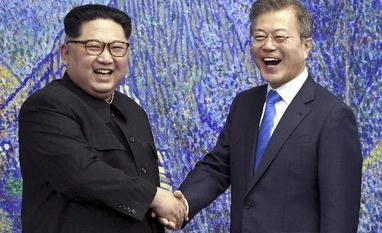
Both Moon and Kim had met thrice and reached a series of agreements aimed at boosting inter-Korean exchanges and reducing tensions. However, ties came under strain this year after Pyongyang slammed Seoul for its failure to stop North Korean expatriate activists from sending anti-Kim regime propaganda leaflets across the border.
Amid the tensed relations, North Korea in June blew up the joint liaison office, which was set up as a measure to boost inter-Korean cooperation in various fields.
(Only the headline and picture of this report may have been reworked by the Business Standard staff; the rest of the content is auto-generated from a syndicated feed.)
First Published: Sep 23 2020 | 7:26 AM IST

