Polls had suggested the electorate was evenly split on the measure
premium
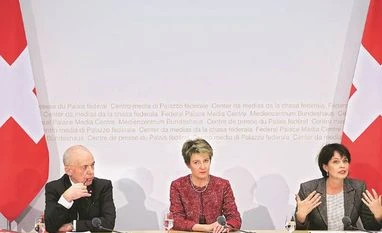
(From left) Swiss Finance Minister Ueli Maurer, Justice Minister Simonetta Sommaruga and President Doris Leuthard at a news conference after the vote on the Corporate Tax Reform Act III in Bern on Sunday
Switzerland shot down the government’s plan to reform corporate taxation, a decision that risks hurting its appeal as a place for multinational companies.
After opponents labelled the reform a series of “complicated tax tricks,” voters opposed it by 59 per cent to 41 per cent, the federal chancellery said on Sunday. Polls had suggested the electorate was evenly split on the measure, which would have given companies reductions for income from patents and research and development activities.
Due to international pressure, Switzerland needs to give up special breaks for multinationals, which generate billions in tax revenue and employ some 150,000 people in the country of 8 million. To stay attractive, the plan included cantons cutting the rates they charge companies across the board. Voters feared this would have strained the public purse and increased the burden on individual taxpayers.
“We’ve succeeded in showing citizens what negative effects this reform would’ve had — we calculated that it would have generated an additional tax burden of 1,000 francs per households and cuts to public services, such as schools,” said Vania Alleva, president of trade union Unia. The result was a “clear sign” to lawmakers that such proposals needed a “social balance,” she said.
The plebiscite is the latest decision that risks damaging the economy in Switzerland, which is one the world’s most affluent countries and regularly tops the World Economic Forum’s global competitiveness index. Following an international crackdown on banking secrecy, stringent limits on executive pay were introduced in 2013 and, the following year, a referendum on immigration quotas threatened to undermine ties with the European Union.
Multinationals generated around 12 per cent of economic output and 9 per cent of employment in 2015, according to consultancy BAK Basel.
Opponents of the reform, notably the Social Democrats, the second-biggest party in parliament, argued the reform would mean more than 2.7 billion francs ($2.7 billion) in lost tax revenue. They called Sunday’s result a “red card” for the “arrogance” of the right. While conceding it would pressure budgets, proponents of the reform, notably businesses and the government, had argued it was the least costly option to keep Switzerland internationally competitive.
Because the rates for domestically oriented companies can be as high as 24.2 perc ent, the ‘No’ vote will force the government to figure out a new set of tax measures to prevent companies from leaving, according to Finance Minister Ueli Maurer. Yet that process could take years, and other countries are considering adjusting their corporate tax regimes to boost their appeal.
“There’s the danger that Switzerland disappears somewhat from the radar of international companies,” Maurer said at a press conference in Bern on Sunday, explaining that in a best-case scenario the government might be able give parliament a draft bill by the end of this year. A committee will take up work in coming days to discuss the way forward, he said. “The danger of shortfalls in tax revenue is real — and the danger of jobs not being moved to Switzerland or moving away is also there.”
The rates Switzerland currently charges are already higher than in Ireland, Hong Kong or Singapore, according to accounting firm KPMG. The UK announced a company tax cut and in the US, President Donald Trump has proposed cutting the business levy to 15 per cent from 35 per cent.
“It’s not good news and it means the uncertainty will continue for the multinationals present in Switzerland,” said Charles Lassauce, member of the board of directors of the Geneva Chamber of Commerce, which was in favor of the reform. “Parliament will have to come up with a new project.”
Read this article for free
Register to continue reading premium journalism and analysis from Business Standard.

 "Swiss reject tax reform, threatening competitive edge")












 Connect with us on WhatsApp