How do you enhance the aesthetic of an email or make an instant message chic? Neither eloquence nor carefully curated emoji can really lift a digital communication beyond the banality of an Amazon receipt. To make a real impression, pull out a pen.
“A handwritten note is elegance incarnate,” said John Z. Komurki, author of “Stationery Fever” (Prestel), a new book detailing the renaissance of writing-related paraphernalia such as pens, pencils, paper and desk sets—not to mention the specialty shops that have popped up globally to serve people who seek the new status of script. These objects and the act of writing, said Mr. Komurki, are “an affordable luxury in a time of crushing vulgarity.”
There’s no doubt that the yen for distinction in the digital world has elevated the value of the written word. And those who care about appearances know they can convey polish and even a certain power through well-chosen writing gear.
“In the main, people have universal tools [for communicating] that are really quite bland,” said Tom Dixon, whose London-based furniture, lighting and interior-design firm added sharply crafted pens and pencils to its collection in 2014. “It’s very hard to distinguish one mobile phone from another.”
Mr. Dixon’s firm joins a host of luxury brands—including French silversmith house Puiforcat and fashion players Hermès and Louis Vuitton—that have begun producing modern but defiantly analog objects for the desk. Like fine mechanical watches, they serve a need their customers could probably satisfy with some digital gadget, but they do so with considerably more style.
Mr. Dixon, as both a businessman and a stylish guy, thinks design and fashion have a place in a market once dominated by specialized brands such as Parker, in America, and Montblanc, in Germany: “For gentleman particularly, there’s always been a dearth of decorative items he can wear—just the belt buckle and watch. It’s nice to have something to hand that gives you the opportunity for self-expression.”
Or bragging rights. In 2014, Australian industrial designer Marc Newson collaborated with Hermès of Paris to introduce its first-ever pen, the $1,670 Nautilus. (Mr. Newson’s three-legged 1990 Lockheed Lounge Chair sold for $3.7 million at a Phillips auction last year.) The smooth stainless-steel and aluminum pen sheathes a soft-close mechanism (like that of high-end kitchen drawers) that retracts the white-gold nib or ballpoint with a twist of the barrel. More recently, Mr. Newson, a member of Apple’s design team, partnered with Montblanc to create another collection of writing tools.
For those who prefer their status symbols more logo-laden, luxury brand Louis Vuitton this January will launch LV Back to Work, its first foray into “office supplies,” producing leather-bound notebooks, lidded boxes, pencil cases and pencils (average price: $350), all identified by the brand’s famous initials.
French silversmith house Puiforcat tapped Joseph Dirand, the architect behind shops for Balmain, Givenchy and Emilio Pucci, to design its “Bureau d’Architecte.” His nine-piece desk collection made of silver- and gold-plated brass (starting at $580) is a minimalist riff, albeit a posh one, on art deco style.
Most of the new generation of writing accouterments highlights quiet style over ostentation. Manhattan stationer Goods for the Study outgrew its 400-square-foot shop in three years, and its new 1,400-square-foot digs in the West Village will include an antique glass case for pens that looks more Madison Avenue tobacconist than strip-mall Staples. But the product on display will steer clear of fat-cat, gold-overlaid fountain pens in favor of custom-welded artisanal versions from Tetzbo in Tokyo, Bauhaus-influenced Lamy pens and imported ink in containers that “look like perfume bottles,” said proprietor Sandeep Salter.
Milanese industrial designer Giulio Iacchetti,who introduced the subdued Neri pen in 2015, billed his creation as “an exercise in absolute minimalism for design junkies and aficionados of writing.” Near the point, a brass thumbscrew adjusts the pencil lead or ink cartridge; otherwise, the tool is an uninterrupted rod of sandblasted aluminum. Equally restrained, Mr. Dixon’s “Cog” collection, with its tool-like cross hatching and gear-like details, pays homage to British mechanical engineering more than William Morris decoration.
Despite this shift toward low-key design, the pens still command attention. The owner of London stationery store Choosing Keeping, Julia (who goes by her first name only), said of those who seek out her wares: “[These people] don’t want to go around with a crystal Bic in their pocket. It looks rubbish when you’re in a meeting, you know?”
Colleagues do take note. A Choosing Keeping customer who bought a raw-aluminum Kaweco AL Sport Ballpoint Pen (about $68) returned to buy another because his tax lawyer had admired it. The finish on the chunky, hexagonal ballpoint, originally designed in 1930s Germany, patinates with use. The store has seen this sort of compliment-driven sale played out numerous times.
Even businesses in a position to exploit the demise of paper and pen are branching out to analog methods. Online invitation and greeting-card service Paperless Post launched a physical stationery collection in 2012, a response to customer demand to print the company’s designs. It sold $500,000 worth of paper products in the first three weeks, and though the private company chose not to reveal any more sales data, co-founder James Hirschfeld admits he was encouraged. “We realized no one lives entirely online or entirely offline,” he said. The company started offering Kate Spade paper stationery in 2012 and Oscar de la Renta paper stationery in 2013.
“Now that [writing] is a choice, I do think there’s something luxurious about opting for the slower, richer format,” Mr. Hirschfeld said.
Companies positioning themselves to stand out know this. As many European fashion brands do, Hermès sends invitations to product previews in envelopes addressed in a near-calligraphic script. New York interior designer Thomas Jayne and his staff recently hand-addressed 300 invitations to his studio’s annual holiday get-together. “If our studio is about personality then nothing conveys personality better than something handwritten,” he said.
British furniture and interior designer Tim Gosling carries a Namiki fountain pen with which Lord Browne Madingley thanked him for outfitting the lord’s new London home. Mr. Gosling gives special attention to penmanship—using purple ink because “it’s the color of Imperial Rome and creates another layer of refinement”—but he didn’t realize the impact his handwriting had until he overheard his housekeeper commenting that reading one of his notes was rather like “receiving a formal decree from Elizabeth the First.”
Perhaps we all channel royalty to some degree when we choose to put pen to paper: As handwriting becomes less common, we are subtly reminded of the status and class that being able to sign a document with more than an X once signified.
In the course of our interviews with Mr. Dixon, he sent us an email that began “I don’t honk...” When asked if this was an arcane Britishism, he replied, “No. It’s autocorrect gone mad.” He added, in reference to those who opt to handwrite: “Maybe superior communication is a more thoughtfully, artfully and carefully constructed message. Clearly the above mistake would not have happened with a good pen and nice paper!” Source: The Wall Street Journal

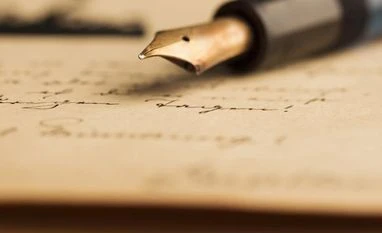 "The new status symbol? Think ink")


 Connect with us on WhatsApp