Japanese-born American Syukuro Manabe, German Klaus Hasselmann, and Italian Giorgio Parisi won the 2021 Nobel Prize for Physics on Tuesday for work that helps understand complex physical systems such as Earth’s changing climate.
In a decision hailed by the UN weather agency as a sign of a consensus forming around man-made global warming, one half of the 10-million Swedish crown ($1.15-million) prize goes in equal parts to Manabe, 90, and Hasselmann, 89, for modelling earth’s climate and reliably predicting global warming.
The other half goes to Parisi for discovering in the early 1980s “hidden rules” behind seemingly random movements and swirls in gases or liquids, which can also be applied to aspects of neuroscience, machine learning and starling flight formations.
“Syukuro Manabe and Klaus Hasselmann laid the foundation of our knowledge of the Earth’s climate and how humanity influences it,” the Swedish Academy of Sciences said in a statement.
“Giorgio Parisi is rewarded for his revolutionary contributions to the theory of disordered materials and random processes.” Hasselmann, who is at the Max Planck Institute for Meteorology in Hamburg, told Reuters from his home that he did not want to wake up from what he described as a beautiful dream.
The Academy said Manabe, who works at Princeton University in the United States, had laid the foundation in the 1960s for today’s understanding of Earth's climate. Hasselmann, it said, had developed models about 10 years later that became instrumental in proving that mankind's carbon dioxide emissions cause rising temperatures in the atmosphere.
Parisi, who dialled into the media briefing, was asked for his message to world leaders due to meet for UN climate change talks in Glasgow, Scotland, from October 31. "I think it is very urgent that we take real and very strong decisions and we move at a very strong pace,” said the 73-year-old laureate who works at Sapienza University of Rome.
Read this article for free
Register to continue reading premium journalism and analysis from Business Standard.

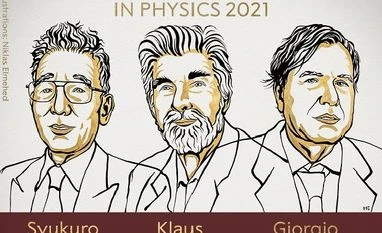 "Trio get Physics Nobel for work on climate change, complex physical systems")












 Connect with us on WhatsApp