Nobel physics prize goes to 3 for work on complex physical systems

'Complex systems are characterised by randomness and disorder and are difficult to understand,' the Swedish Academy of Sciences said in a statement
Nobel
AP PTI
2 min read Last Updated : Oct 05 2021 | 3:56 PM IST
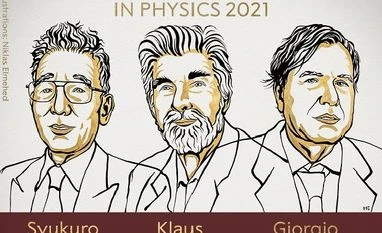
The Nobel Prize for physics has been awarded to scientists from Japan, Germany and Italy.

Syukuro Manabe, 90, and Klaus Hasselmann, 89, were cited for their work in “the physical modeling of Earth's climate, quantifying variability and reliably predicting global warming”.

The second half of the prize was awarded to Giorgio Parisi, 73, for “the discovery of the interplay of disorder and fluctuations in physical systems from atomic to planetary scales.” The panel said Manabe and Hasselmann “laid the foundation of our knowledge of the Earth's climate and how humanity influences it.

Starting in the 1960s, Manabe demonstrated how increases in the amount of carbon dioxide in the atmosphere would increase global temperatures, laying the foundations for current climate models.

About a decade later, Hasselmann created a model that linked weather and climate, helping explain why climate models can be reliable despite the seemingly chaotic nature of the weather.

He also developed ways to look for specific signs of human influence on the climate.

Parisi “built a deep physical and mathematical model” that made it possible to understand complex systems in fields as different as mathematics, biology, neuroscience and machine learning.

After the announcement, Parisi said that “it's very urgent that we take very strong decisions and move at a very strong pace” in tackling climate change.

“It's clear for future generations that we have to act now,” he said.

The winners were announced Tuesday by Goran Hansson, secretary-general of the Royal Swedish Academy of Sciences.
It is common for several scientists who work in related fields to share the prize.

The prestigious award comes with a gold medal and 10 million Swedish kronor (over USD 1.14 million). The prize money comes from a bequest left by the prize's creator, Swedish inventor Alfred Nobel, who died in 1895.

On Monday, the Nobel Committee awarded the prize in physiology or medicine to Americans David Julius and Ardem Patapoutian for their discoveries into how the human body perceives temperature and touch.

Over the coming days prizes will also be awarded for outstanding work in the fields of chemistry, literature, peace and economics. 

One subscription. Two world-class reads.

Already subscribed? Log in

Subscribe to read the full story →
*Subscribe to Business Standard digital and get complimentary access to The New York Times

Smart Quarterly

₹900

3 Months

₹300/Month

SAVE 25%

Smart Essential

₹2,700

1 Year

₹225/Month

SAVE 46%
*Complimentary New York Times access for the 2nd year will be given after 12 months

Super Saver

₹3,900

2 Years

₹162/Month

Subscribe

Renews automatically, cancel anytime

Here’s what’s included in our digital subscription plans

Exclusive premium stories online

  • Over 30 premium stories daily, handpicked by our editors

Complimentary Access to The New York Times

  • News, Games, Cooking, Audio, Wirecutter & The Athletic

Business Standard Epaper

  • Digital replica of our daily newspaper — with options to read, save, and share

Curated Newsletters

  • Insights on markets, finance, politics, tech, and more delivered to your inbox

Market Analysis & Investment Insights

  • In-depth market analysis & insights with access to The Smart Investor

Archives

  • Repository of articles and publications dating back to 1997

Ad-free Reading

  • Uninterrupted reading experience with no advertisements

Seamless Access Across All Devices

  • Access Business Standard across devices — mobile, tablet, or PC, via web or app

Topics :Nobel Prize

Next Story



