US bombers train over South Korea ahead of Donald Trump's visit

Trump arrives in Asia on Sunday, beginning his first trip to the region as president in Japan before heading to South Korea and China, then Vietnam and the Philippines
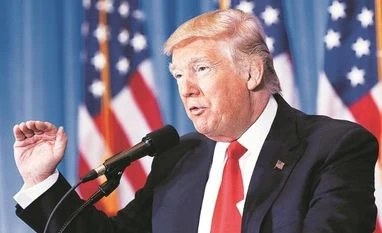
Donald Trump, Trump
Donald Trump
Reuters
Last Updated : Nov 03 2017 | 8:19 AM IST
Two US strategic B-1B bombers conducted drills over South Korea on Thursday, the US Air Force said, days before President Donald Trump arrives in the country amid high tensions with North Korea over its nuclear weapon programme.

News of the drills was first reported by North Korean state news agency KCNA on Friday, which said the exercises involving South Korean and Japanese fighter jets were a “surprise nuclear strike drill”.

“The reality clearly shows that the gangster-like US imperialists are the very one who is aggravating the situation of the Korean peninsula and seeking to ignite a nuclear war,” KCNA said.

Trump arrives in Asia on Sunday, beginning his first trip to the region as president in Japan before heading to South Korea and China, then Vietnam and the Philippines.

A series of missile tests by North Korea and its sixth and largest nuclear test have fuelled the most critical international challenge of Trump’s presidency.

The goal of Trump’s visit will be to increase international support for efforts to deprive North Korea of resources as leverage to coerce it to give up nuclear weapons, US officials said.

“The president recognises that we’re running out of time (to deal with North Korea) and will ask all nations to do more,” White House national security adviser H.R. McMaster told reporters at a briefing in Washington.

McMaster said Trump, who has approved a variety of sanctions against North Korea while pressing China to do more, is at the beginning of his drive for Pyongyang to give up nuclear weapons. Trump has warned he would “totally destroy” North Korea if it threatened the United States.

“I think we have to be a little patient here for at least a few months to see what more we and others can do, including China,” said McMaster. “I don’t think we need to reassess our strategy now. I think we have to give it a couple of months, a few months, and then see what adjustments we might need to make.”

China’s influential state-run tabloid the Global Times said in an editorial on Friday that pressing China will not help solve the Korean peninsula nuclear crisis.

“The complexity of the nuclear crisis means that all sides may have to make some concessions to reach a peaceful solution. China is playing the most difficult role in the process, and is the real hope of peacefully addressing the crisis. Neither side should press China in an extreme way,” it said.

SHOW OF FORCE

Ahead of Trump’s visit to Asia, the drills involving the nuclear-capable U.S. bombers marked the latest show of force by the United States and its allies.

The bombers flew through South Korean airspace and over the country’s Pilsung Range training area in central South Korea, Air Force spokeswoman Captain Victoria Hight said.

Japanese and South Korean fighter jets carried out sequenced missions with the U.S. bombers but no ordnance was dropped, the Air Force said.

The drill was staged at a time when three U.S. aircraft carrier groups are in the Asia-Pacific, the first time such a potent projection of force has been together in the region in a decade.

U.S. officials said earlier this week a decision may be made for the three carriers to carry out a joint exercise to coincide with Trump’s trip.

KCNA said the combination of the bomber drills with the presence of the carrier groups underscored the gravity of the situation.

“The U.S. imperialists are making last-ditch efforts to check the dynamic advance of the DPRK by deploying their nuclear strategic assets in succession, but its army and people are never frightened at such moves,” KCNA reported, referring to North Korea by its official initials.

“The U.S. imperialist warmongers should not act rashly.”

One subscription. Two world-class reads.

Already subscribed? Log in

Subscribe to read the full story →
*Subscribe to Business Standard digital and get complimentary access to The New York Times

Smart Quarterly

₹900

3 Months

₹300/Month

SAVE 25%

Smart Essential

₹2,700

1 Year

₹225/Month

SAVE 46%
*Complimentary New York Times access for the 2nd year will be given after 12 months

Super Saver

₹3,900

2 Years

₹162/Month

Subscribe

Renews automatically, cancel anytime

Here’s what’s included in our digital subscription plans

Exclusive premium stories online

  • Over 30 premium stories daily, handpicked by our editors

Complimentary Access to The New York Times

  • News, Games, Cooking, Audio, Wirecutter & The Athletic

Business Standard Epaper

  • Digital replica of our daily newspaper — with options to read, save, and share

Curated Newsletters

  • Insights on markets, finance, politics, tech, and more delivered to your inbox

Market Analysis & Investment Insights

  • In-depth market analysis & insights with access to The Smart Investor

Archives

  • Repository of articles and publications dating back to 1997

Ad-free Reading

  • Uninterrupted reading experience with no advertisements

Seamless Access Across All Devices

  • Access Business Standard across devices — mobile, tablet, or PC, via web or app

Next Story



